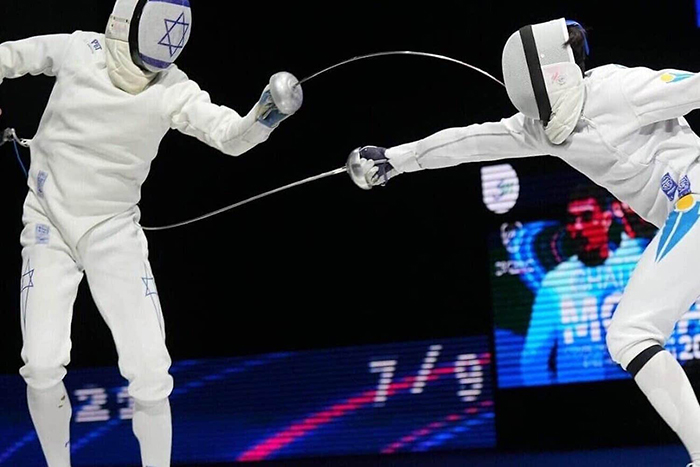
An Israel fencer in action at the 2025 Fencing World Championships held in Tbilisi, Georgia. Photo courtesy of the International Fencing Federation.
JNS
Fencing is one of those sports you don’t hear much about, except perhaps during the Olympics, and so you probably don’t know there is currently a boom in Israeli fencing.
Although the team did not win a medal at the recent Fencing World Championships, it is building up to something special, Israeli insiders told JNS. At the World Championships held in Tbilisi, Georgia, from July 22-30, Israel finished 11th out of 46 in the men’s team épée, which in itself is a remarkable achievement, 22 months into the current war.
Jews And Fencing?
Fencing is one of just five sports (the other four being athletics, cycling, gymnastics and swimming) that have featured in every summer Olympics. It receives the least attention of the five outside of the Games, but there is a rich connection between the sport, Jews and Israel.


Prof. Udi Carmi is the dean of students at Tel-Hai Academic College in the Galilee and a researcher and lecturer in the history of sport who has written extensively about the subject of Jews and Israelis in fencing.
“Just like there was a wave of Jewish boxers in the early part of the 20th century, there was a great Jewish presence in fencing,” Carmi told JNS. “With strong anti-Semitism, especially in Europe, being a top athlete provided power, recognition and social standing. Not only was fencing one of the few options available to Jews then, but the cerebral nature of the sport made it very attractive.”
Fencing, Carmi noted, is the second most successful Olympic sport for Jewish athletes, just behind swimming—and swimming only recently overtook it.
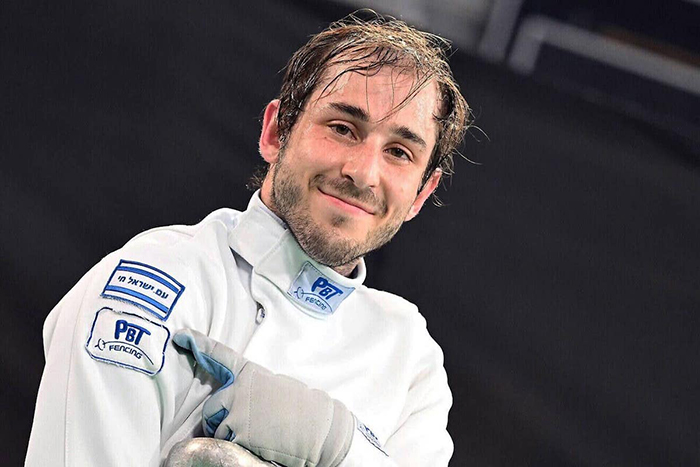
Israel’s 2024 Olympic fencer and 2019 European champion, Yuval Freilich. Photo courtesy of the International Fencing Federation.
Yuval Freilich: Olympic fencer
Israel made its Olympic debut in 1952 and had its first Olympic fencers in 1960. Thereafter, it sent fencers to eight other Games, which it did quite consistently until 2012.
Yuval Freilich broke the drought last year in Paris when he became Israel’s first Olympic fencer in 12 years. He had high hopes heading into the 2024 Olympics, but unfortunately lost his opening match and in the sudden-death format of the sport, that was that.
Reflecting on his Olympic experience, Freilich expressed mixed emotions. “There is a lot of disappointment after there was an incredible amount of hard work just to make it, but it was an amazing privilege to compete at the Olympics,” he told JNS.
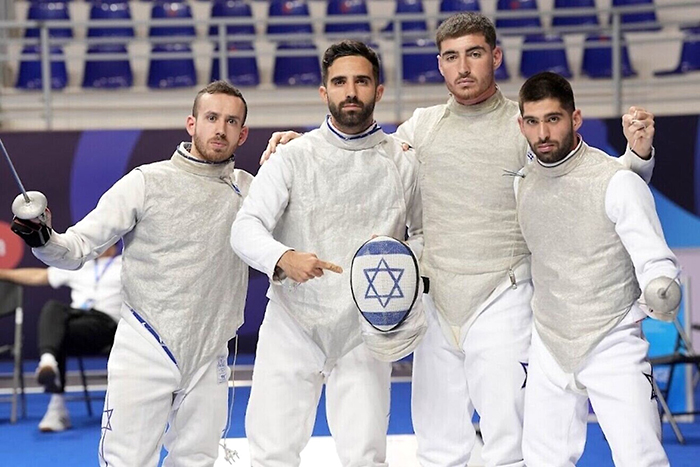
Israeli fencers at the 2025 Fencing World Championships in July. Photo courtesy of Team Bizzi/Israel Fencing Association.
Various Disciplines
Freilich fences with an épée, which, along with foil and sabre, is one of the three disciplines in fencing. For all intents and purposes, they are completely different sports, much like swimming has different strokes.
Freilich is also a member of the men’s épée team and is proud of the progress the team has made in recent years. “Men’s épée has become more consistent, stable, and we have the potential to succeed,” he said. “This has enabled us to become more professional and perform at a higher level. We train together, and the results are coming.”
Freilich is the pioneer of Israeli fencing and helped usher in this new era. In 2019, he won Israel’s first-ever gold medal at the European Fencing Championships. Since then, Israel has won gold medals in fencing at events such as the Junior World Championship, Junior European Championships, Senior Grand Prix, Cadet European Championships and the U23 European Championships.
The holy grail is the Olympics, but Israeli fencing Olympian Noam Mills doesn’t think an Olympic medal is impossible. “This is a peak time for Israeli fencing and the strongest it’s been since we had three Olympic fencers in 2008,” she said. “Not only are they good fencers, but they’re also young, which means they’ll be around for a while.”
Targeting a medal
Yossi Harari is the chairman of Israeli fencing, a position he has held since 2020. Part of the significant improvement in Israeli fencing in recent years has to do with COVID-19—maybe one of the few good things to come out of that surreal period.
“At the beginning of 2020, the Corona (COVID) pandemic forced us to change the training method and train exclusively in closed camps,” he told JNS. “We immediately noticed the high motivation and improvement in the fencing level of the fencers and now hold over 120 training days and camps a year. We opened a fencing academy for boys and girls in full cooperation with the Olympic Committee and the Unit for Achievement Sports.”
Three-time Israeli Olympic fencer Lydia Hatuel-Czuckermann is looking forward to the 2028 Los Angeles Olympics—and not just for the competition. Back in 1984, she made her Olympic debut there and has very fond memories of those Games.
“There has been a lot of development since I fenced, especially in épée. I’m proud of them and the progress made,” she said. “This could be the start of an exciting period in Israeli fencing.”
The Los Angeles Games are now just under three years awayand according to Harari, Israel fencing has very clear goals. “We hope to qualify a men’s épée team, a single athlete in men’s and women’s foil and also one in women’s épée,” Harari told JNS. “In the Olympic Games themselves, we believe that we can achieve at least one medal.”
The New Judo?
According to Mills, the impact of that medal can’t be understated. “There is no reason why Israel winning a medal at the Olympics couldn’t have the same impact as winning medals had for judo in the 1992 Olympics,”he said. “Israel never had a talent issue—it was all about nurturing the talent and creating the platform to succeed. If we can start to do it consistently, there is no reason why we can’t put fencing up there with judo and windsurfing.”
Judo and windsurfing have been Israel’s two most successful Olympic sports, responsible for 14 of the 20 medals Israel has won to date.