
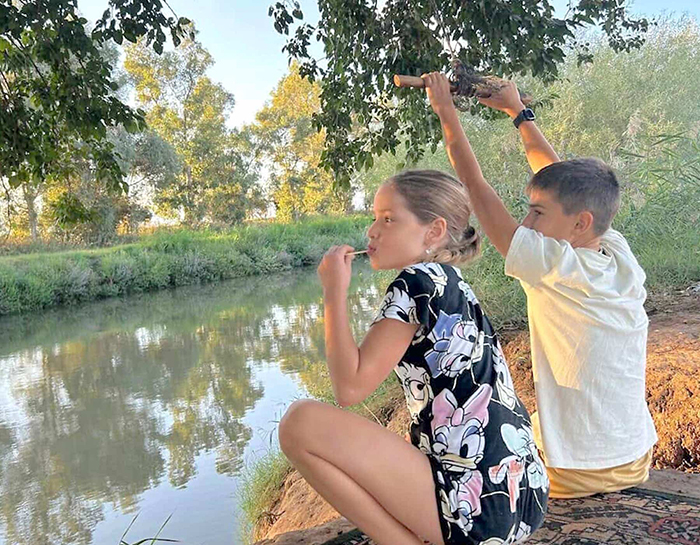
Mia and Roii Adar. Photo courtesy of Daniella Adar.
JNS
The excited chatter of youth reunited after summer vacations and almost 23 months of war echoed in schools throughout Israel. But for the Adar children and their friends, “back to school” means more than sharpened pencils and new backpacks. For them, like tens of thousands of children in northern Israel, it is the hope of reclaiming a normal childhood after being uprooted from their homes under fire from Hezbollah nearly two years ago.
Stability Sought
“My only wish for them is that they get to start—and finish—this year in the same school,” says their grandmother Daniella, whose home in Yesud HaMa’ala, the first modern Jewish community in the Hula Valley, became a sanctuary during the upheaval. For months, the children slept in her bed at night, finding safety and comfort.
For 13-year-old Roii and his 10-year-old sister, Mia, from Kibbutz Dafna, and their 8-year-old cousin Leni from Kibbutz Shamir, the past two years have meant abandoned classrooms, lost friends and the constant question of when, or if, they would ever return home.


For Roii and Mia, the upheaval began on Oct. 7, 2023, when their families were evacuated from Dafna following the massacres by Hamas in the Western Negev and the subsequent Hezbollah bombardments along the northern border. Dafna, established in 1939 as a “Tower and Stockade” community and located a few miles east of Kiryat Shmona, was officially evacuated along with other communities on the northern frontier and in the Upper Galilee.
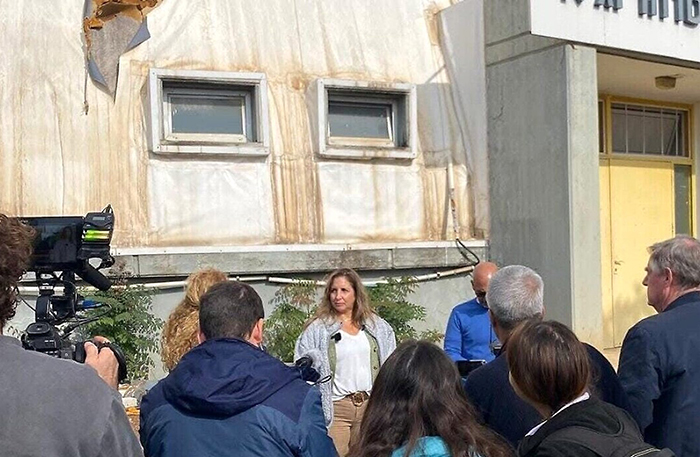
A Hezbollah missile damaged the roof of the school sports hall at Kibbutz Dafna. Photo courtesy of Kibbutz Dafna.
A Long Day Trip
Mia remembers, “When my parents woke me up, they told me we were going on a fun day trip, like we often do. I only found out we weren’t going home a few hours after we left.” She adds, “At first, the evacuation felt almost like an adventure, at least for the children. The family gathered at Daniella’s home in Yesud Hamaala, joined by cousins and friends.
“It was fun,” Roii recalls. “It felt like a holiday. No school, big family meals, three of my friends from Dafna were there. We met every day.”
Chaotic Schooling
When the fighting continued on, their parents sought a more permanent solution and moved to Ein Gev on the Sea of Galilee. The children attended a pop-up school staffed by soldier-teachers. “Those first months were chaotic,” explains their father, Tom. “School wasn’t a top priority for anyone.”
For the children, the lack of stability was jarring. “I had only one friend there,” says Roii.
Mia adds that “it wasn’t a great school. The teachers tried to talk to us about the situation, but it didn’t help. I didn’t feel good inside.”
Tight Living Conditions
A few months later, they moved again, this time to Kibbutz Ha’on. Most of their friends from Kibbutz Dafna also relocated, along with experienced teachers, some of whom they knew from home.
At Ha’on, the school day ran until 1 p.m., followed by meals and afternoons of swimming and play on the expansive grass. “It was the first time since the war began that they felt like kids again,” Tom says. But living conditions were tight: The family shared one room, with no privacy. Arguments flared. Some tough decisions had to be made.
“We realized it was more important to restore a healthy family framework than just keep them happy,” Tom explains. “We decided for the sake of our family, we had to move somewhere that offered more privacy and more rooms.”
Back To Grandmother’s
At first, the kids were hesitant to leave Ha’on, fearing that they’d need to make new friends and navigate an unfamiliar school yet again. Their parents assured them that they could move back if they were unhappy.
Eventually, the family rented a home near Daniella in Yesud Hamaala. The children found new friends, and their father reconnected with childhood companions. At night, Daniella’s home, with a safe room within the house, remained a refuge. “They felt safe only when we were all together,” she says.
Last September, Roii was due to start junior high at Dafna’s regional school. He was disappointed that the school remained closed and that a temporary junior high had been opened for children of the region in the industrial park near Rosh Pina.
New Understanding Of Danger
“For years, he had been looking forward to rolling out of bed and taking two steps to his junior high just meters from home, surrounded by his friends and the fabulous nature around us,” says Tom. “Instead, he and his peers had to travel far away and learn in temporary caravans in an industrial park.”
However, when a missile tore through the roof of the junior high sports hall at Kibbutz Dafna—fortunately, while it was empty, due to the evacuation—Roii grasped the seriousness of the situation. “It took seeing the missile go through the roof for Roii to fully understand why we couldn’t return home yet,” says Tom. “It made it easier for him to accept because suddenly, it wasn’t just adults telling him the danger was real. He saw it with his own eyes.”
Leni’s path was different. Unlike Dafna, Kibbutz Shamir was never officially evacuated. Still, the constant rocket threats and non-stop air-raid sirens convinced many parents to leave with their children. Leni’s mother joined them, relocating to the Jezreel Valley.
“To change schools and make new friends was difficult,” Leni admits, “but it was fun to be with my old friends from Shamir, too.”
Eventually, the families returned to Shamir. For Leni, the homecoming was exciting, though the past two years had made her grow up quickly.
“When she left Shamir, she was just a couple of months into first grade,” says Daniella. “Now, she’s heading into third grade with so many experiences under her belt.”
‘It’s Not Always Easy’
In the spring of 2025, after a ceasefire agreement was signed on Nov. 27 by Israel, Lebanon and five mediating countries, including the United States, Dafna residents were finally allowed to return home.
“When I learned we were going home, it was the happiest day of my life,” says Mia. But the return was bittersweet. “The kibbutz looked different. Even after we cleaned the house, it felt different. I realized that I have changed, but the kibbutz stayed the same. Even my friends are different; we used to play with dolls, but not anymore. We need to get to know each other all over again. It’s not always easy.”
Family Routines
For Roii, the first week back was filled with fear. “I was scared of the booms from across the border,” he acknowledges. Slowly, he adjusted, spending time with friends at a riverside hangout they built themselves and finally being able to breathe again, surrounded by the nature that they love.
But his homecoming is not without challenges. One of his best friends won’t be returning to the kibbutz at all. “Before the war, we were kids,” he says, adding, in words wiser than his age, that two years later, everyone has grown up so much, and home feels a bit different.
Tom and his wife tried to reintroduce family routines as soon as they returned, taking the children on regular hikes as they did before the war. “At first they were terrified to leave the perimeter,” he says. “But by the end, it was the best thing we could do to create a sense of normalcy.”
Daniella, watching her grandchildren adapt, reflects: “These past two years have made them grow up fast. Despite everything, they’re excellent students, wise beyond their years. I am so proud of them.”
Looking back, Mia does not mince words, saying that “it was the worst two years of my life.” Tom sees something else: “In the end, kids have shown more resilience than us adults. We can only pray that September ushers in a normal, uninterrupted year for our children and for all the children of Israel.”