
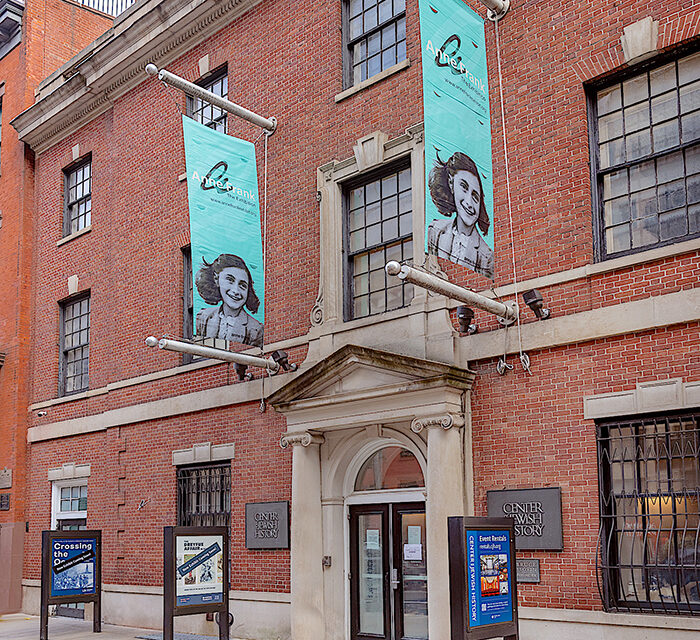
Outside the Anne Frank The Exhibition at the Center for Jewish Historyin NYC. The exhibition will remain open through Feb. 1
NEW YORK CITY –Encouraged by demand, the Anne Frank House has announced the final extension of its world premiere presentation of Anne Frank The Exhibition in New York City at the Center for Jewish History. The exhibition will remain open through Feb. 1, 2026, before moving to another U.S. city.
“It has become powerfully evident since the opening of this exhibition that people from every walk of life feel a deep, urgent need to connect with Anne’s story and confront the realities of the Holocaust firsthand. The reflections and courageous conversations sparked by every visitor have shown how this exhibition has a role in challenging hate,” said Ronald Leopold, executive director of the Anne Frank House. “Our responsibility to honor Anne’s legacy grows stronger each day. Extending the exhibition is a necessary response to the troubling state of anti-Semitism and hatred around the world. And soon, we will introduce an innovative resource designed to help educators and students build a deeper, more informed understanding of anti-Semitism—at a moment when consensus is most at risk. We are unwavering in our resolve to fight all forms of hate, fueling understanding and resilience through education.”
Since its opening, the exhibit has drawn hundreds of thousands of visitors, including students, teachers, and librarians from almost every state across the nation and more than a dozen countries, providing an immersive experience in the heart of Manhattan and offering historical context through never-before-seen artifacts, multimedia, and Anne’s personal narrative.
It is the first time that the Anne Frank House presents an experience outside of Amsterdam to immerse visitors in a full-scale recreation of the annex rooms, fully furnished, where Anne Frank, her parents and sister, and four other Jews spent two years hiding to evade Nazi capture.
Moving through the exhibition, visitors can immerse themselves in the context that shaped Anne’s life—from her early years in Frankfurt through the rise of the Nazi regime and the family’s phased move to Amsterdam across 1933 and 1934, where Anne lived for 10 years until her 1944 arrest and deportation to Westerbork, a large transit camp in the Netherlands, then to Auschwitz-Birkenau, a concentration camp and killing center in Nazi-occupied Poland, and eventually to her death at Bergen-Belsen concentration camp in Germany when she was 15 years old.
The New York City exhibition occupies over 7,500 square feet of gallery space in the heart of Union Square. This marks the first time dozens of artifacts can be seen in the United States—many have never been seen in public.


Artifacts in the exhibition include: Anne Frank’s first photo album (1929-1942); Anne Frank’s typed and handwritten invitation to her friend for a film screening in her home (by 1942, anti-Jewish measures prohibited Jews from attending the cinema); and handwritten verses by Anne Frank in her friends’ poetry albums.
General admission tickets are available every day the exhibition is open, and complimentary admission will be offered to select visitors on a variety of dates. Information may be obtained from the Center for Jewish History, 5 W 16th St, New York City, 212- 294-8301, https://www.cjh.org/visit/plan-your-visit.