
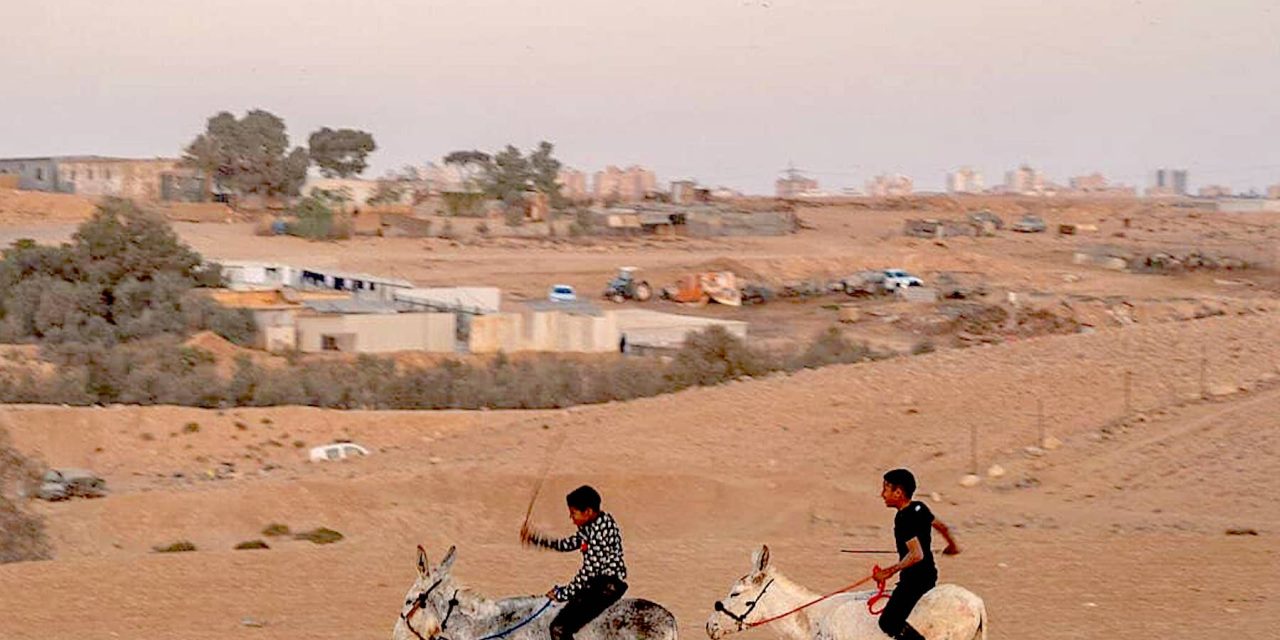
CAPTION: An unrecognized Bedouin village in the Negev Desert, Nov. 21, 2024. Photo courtesy of Yaniv Nadav/Flash90.
By RAWAN OSMAN, ALON TAL
JNS
The Negev has entered a dangerous phase. A surge of violence within Bedouin communities, alongside growing friction and attacks affecting nearby Jewish towns, reflects more than local criminality. It signals a deeper erosion of state authority in Israel’s south, one that threatens public safety, social cohesion and national security.
Implications For Government
Polygamy is one of the clearest indicators of this breakdown. Long treated as a social issue, a women’s rights concern, or a cultural practice best handled delicately, it has been systematically misdiagnosed. What is unfolding in the Negev is not a private family matter, but a structural phenomenon with direct implications for governance and sovereignty.
Polygamy has become a vehicle for cross-border infiltration, demographic distortion and the erosion of loyalty to the state.
What Is The Threat?
Polygamy is illegal in Israel. Yet in the Negev it persists at scale, expands with minimal deterrence, and is routinely tolerated by state authorities. This failure is not benign. It has enabled the large-scale importation of women from Gaza and other Palestinian-controlled areas through unregistered and polygamous marriages, often bypassing immigration controls, civil registration, and meaningful security screening.
Under Israeli law, a child born to one Israeli parent is entitled to Israeli citizenship, even when the other parent has no legal status. In isolation, this reflects a humane citizenship framework. In the context of widespread polygamy, however, it creates a multiplying effect.
Family Ties
In parts of the Bedouin sector where unregistered marriages are common, a single Israeli citizen can lawfully transmit citizenship to multiple family units, dramatically amplifying the demographic and civic impact of each case.


While precise data are lacking, security officials and policymakers increasingly warn that this legal structure is being deliberately exploited, with Palestinian families marrying daughters to Israeli Bedouin men as a pathway into Israeli society through citizenship transmission. The absence of figures does not negate the concern; it exposes a structural blind spot that the state has failed to address.
This is not theoretical. Ismail Haniyeh, Hamas’s leader until his assassination in 2024, had close family members living in the Negev, including sisters who were Israeli citizens residing in Tel Sheva. Several relatives were arrested over the years on serious criminal and security-related charges.
The issue is not guilt by association, but vulnerability by design: the leader of a genocidal terror organization maintained intimate family networks inside Israel, embedded in communities where law enforcement is already weak.
Security professionals have long warned that family ties are among the most powerful loyalty-forming mechanisms in Middle Eastern societies. When those ties extend into Gaza and Hamas-controlled environments, the implications are obvious. In times of escalation, familial loyalty can come into direct conflict with national loyalty, particularly where state authority is already contested and illegal norms are entrenched.
Polygamy does not exist in isolation. It is embedded in a broader ecosystem of illegality: illegal construction on state land, welfare fraud, falsified or absent civil registration, harboring of illegal residents, weapons offenses and chronic non-compliance with planning and security authorities.
Expanding Population
These are not random violations. They form a coherent system sustained by the expectation of non-enforcement. Areas where the law is optional quickly become areas where sovereignty is challenged.
Demography magnifies the threat. Polygamous households drive exceptionally high birth rates, particularly in illegal or unrecognized settlements, producing population growth far beyond state planning assumptions. The result is a rapidly expanding population concentrated in areas with weak infrastructure, poor educational outcomes, low labor-market participation and limited integration into Israeli civic life. This is not merely a socioeconomic failure; it is a long-term security risk.
Public funds unintentionally deepen the problem. Polygamous households rely disproportionately on welfare transfers rather than earned income. Child allowances, unemployment benefits, and disability payments often sustain illegal family structures. When the state systematically subsidizes illegality, it ceases to be neutral and becomes complicit.
This is often framed as a humanitarian dilemma: enforce the law or harm vulnerable populations. That framing is false. The absence of enforcement has not protected women or children; it has entrenched their vulnerability.
Culture Or Sovereignty?
Women brought into Israel through illegal polygamous marriages, often without legal status, live under extreme dependency and control. Children raised in these environments face neglect, poor schooling, and social alienation, making them more susceptible to criminal and extremist influence.
Culture is frequently invoked as a shield against intervention. But sovereignty cannot be outsourced to tradition. Practices that violate criminal law, undermine gender equality, distort demographic planning and weaken national security are not cultural expressions deserving immunity.
Israel has convened committees, commissioned reports, and issued recommendations. Yet the central failure remains unchanged: deterrence has been absent. Social services without enforcement function as incentives. Education without accountability cannot compete with a system that rewards illegality.
This is not a call for collective punishment. It is a call to restore the basic premise of statehood: that the law applies everywhere, to everyone, consistently. Enforcement, paired with protection, legal pathways, and exit options for women and children, is not repression; it is governance.
Polygamy in the Negev is no longer a marginal social issue. It is a security stress test for Israel’s ability to maintain sovereignty over a strategic region, prevent internal erosion driven by cross-border hostile networks, and uphold the rule of law.
Israel still has the capacity to act. What remains in question is whether it has the will to treat polygamy not as a cultural inconvenience, but as what it has become: a strategic liability and threat.