By VICKY TALBOT
PR & Advertising Director,
The Jewish World
In Polish, the word for grandmother is Babcia.
In my family, Babcia was the center of everything.
I am the great-granddaughter of Arthur Szyk, the renowned Polish-Jewish artist whose work chronicled Jewish history, identity, and resilience. While his legacy lives on through art, his daughter—my grandmother, Alexandra Bracie—kept our family traditions alive through food, hospitality, and an open table.
My Babcia was born in Paris and raised between Poland and France, shaped by European Jewish cooking and Old World entertaining. She cooked generously and often, welcoming family, friends, and guests wherever she was—whether in Scarsdale, New York, or during her winters in Palm Beach, Highland Beach, and Boca Raton, Florida. Her kitchen was a place of warmth, conversation, and connection.
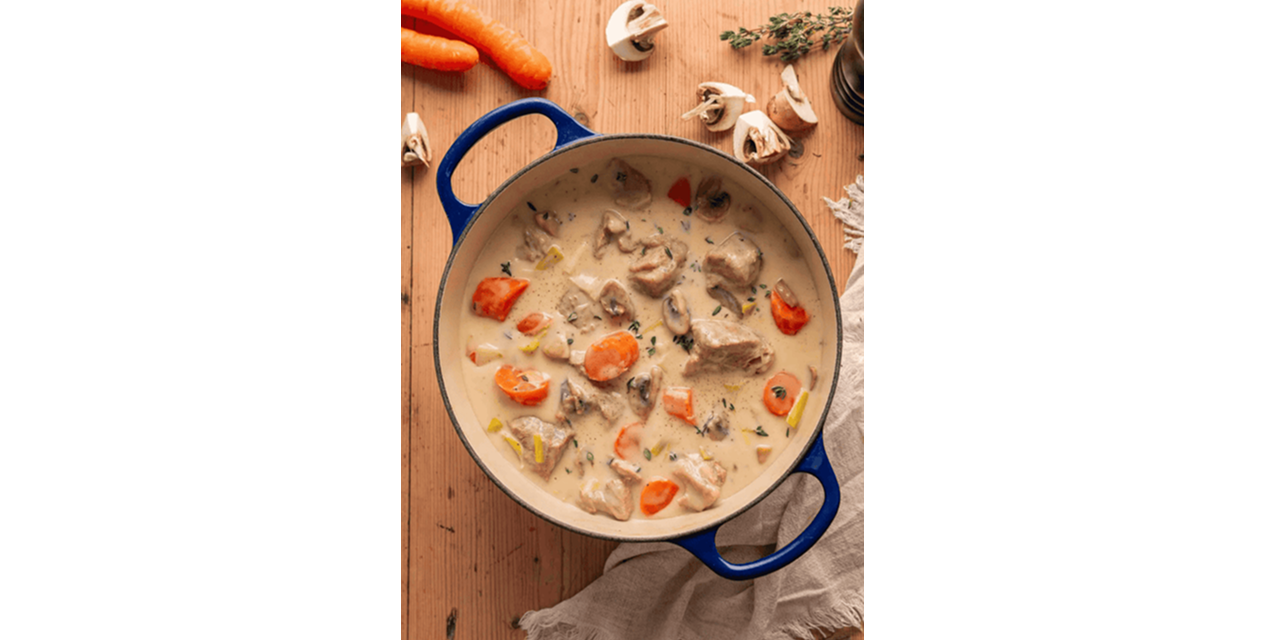
She taught me many family recipes, and this veal stew remains one of my favorites. It is elegant yet comforting, slow-cooked entirely on the stovetop, and meant to be shared. Served over white rice or egg noodles with warm French bread, it is a dish that brings people together.
A Note on Jewish Tradition
For many Jewish families, the tradition of not mixing meat and dairy is an important part of keeping a kosher or kosher-style kitchen. For readers who observe this practice, this recipe can be prepared easily using non-dairy butter and non-dairy heavy cream substitutes.
Local markets such as Price Chopper carry a variety of dairy-free butters and dairy-free cream options, making it simple to honor Jewish dietary traditions while enjoying classic family recipes.


Babcia Alexandra’s Veal Stew
(Adaptable for Meat-and-Dairy Separation)
Serves: 5–6
Total Time: Approximately 3 hours
Cooking Method: Entirely stovetop
Ingredients
Veal & Broth
- 2 lbs veal, cut into 2-inch cubes
- Cold water (for blanching)
- 4 cups chicken broth (low sodium preferred)
- 1 large onion
- 2 whole cloves
- 4 garlic cloves, smashed
- 3 carrots, sliced lengthwise
- 2 celery stalks, sliced lengthwise
- 2 tablespoons fresh parsley, chopped
- Salt, to taste
- Freshly ground black pepper, to taste
Mushroom & Wine Reduction
- 2 cups mushrooms, sliced
- 2 tablespoons butter or non-dairy butter
- 1 cup white wine (preferably a good Chardonnay)
Sauce & Finish
- 2 tablespoons butter or non-dairy butter
- 3 tablespoons all-purpose flour
- 1 cup heavy cream or non-dairy substitute
- 1 cup frozen pearl onions
- 2 tablespoons brown sugar
- ⅓ cup cooking sherry
For Serving
- White rice or egg noodles
- Warm French bread
Instructions
1. Blanch the Veal
Place the veal cubes in a large pot and cover with cold water.
Starting with cold water helps keep the meat tender.
Bring to a boil and cook for 3 minutes.
Remove the veal with a slotted spoon and skim off any foam. Set aside.
2. Slow-Cook the Veal
In a large Dutch oven, combine:
- Chicken broth
- Onion studded with the two cloves
- Garlic
- Carrots
- Celery
- Veal
- Salt and pepper
Bring to a gentle simmer. Cover and cook on the stovetop for 1½ hours, until the veal is tender.
3. Strain and Separate
Discard the onion and celery.
Place the veal and carrots into separate bowls.
Strain the broth until clear and measure 4 cups. Set aside.
Wash the Dutch oven and return it to the stove.
4. Mushroom & Wine Reduction
Melt butter or non-dairy butter in a sauté pan over medium heat.
Add mushrooms and cook for 5 minutes, until softened.
Add the white wine and cook for 3 minutes, allowing it to reduce slightly.
Remove mushrooms and set aside. Add the reduction liquid to the broth.
5. Make the Sauce
In the Dutch oven, melt butter or non-dairy butter and whisk in the flour to form a smooth paste.
Slowly whisk in the broth, then add the cream or non-dairy substitute.
Simmer gently for 5 minutes, until smooth and slightly thickened.
6. Finish the Stew
Add veal, carrots, mushrooms, pearl onions, brown sugar, and cooking sherry.
Simmer uncovered on medium-low heat for about 20 minutes, stirring occasionally, until the sauce reduces by half and becomes rich and silky.
Season to taste.
To Serve
Serve hot over white rice or egg noodles, with warm French bread to soak up every drop of sauce.
A dish meant to be shared—rooted in family, memory, and Jewish tradition—from Paris to New York.