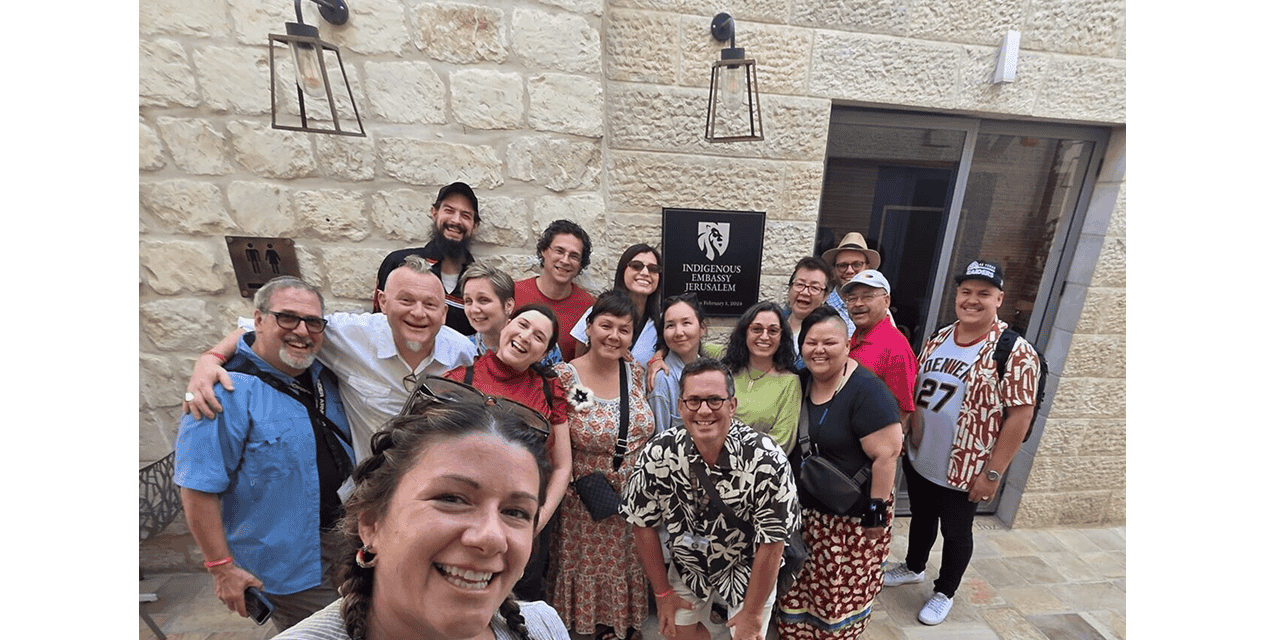
Crystal Lavallee, front left, a filmmaker from the Niagara area in Ontario who is of Métis and Greek descent, with fellow indigenous Canadians in front of the Indigenous Embassy Jerusalem in September 2025. Credit: Courtesy.
By DAVE GORDON
JNS
Canadians of indigenous ancestry are still mulling over a trip they took to Israel last fall and are looking forward to the release of a documentary about that experience. “The Lands Between Us” is slated to be screened in early March in Montreal, Ottawa, Toronto and Vancouver with support, in part, from the Israeli embassy in Canada.
Pain, Memory And Hope
“I miss being on the land and with the people,” Crystal Lavallee, a filmmaker from the Niagara area in Ontario, who is of Métis and Greek descent, told JNS. “Witnessing both the highs and lows of what the Jewish people have faced, and still face, alongside other First Nations, Métis and Inuit participants deepened our connection and understanding.”
“There are powerful parallels between Jewish and indigenous histories, in how pain, memory and hope live side by side,” she said.
The film about the September trip, organized by the Israeli embassy in Canada, follows 10 indigenous participants and three non-Indigenous people who are allies of the Jewish people and Israel as they travel across the Jewish state and engage with individuals from a range of cultural and faith backgrounds.
Lavallee accepted the invitation, wanting to see “the reality on the ground,” though she was initially nervous.
Shared Understanding
“When the plane landed, I started crying. It felt like I was home,” she told JNS.


For Lavallee, one of the most powerful parts of the trip was watching Emily and Hugo Hester, survivors of abusive residential schools, visit Yad Vashem, Israel’s Holocaust memorial in Jerusalem. “They connected instantly with the history,” she told JNS. And they certainly “understood what it meant to have your culture targeted and erased. That shared understanding was incredibly moving.”
The trip offered a fuller picture than headlines allow. “I felt safe. People were open, curious and genuinely wanted to connect,” she said. “That humanity is what stayed with me the most.”
Elizabeth Annahatak, from the village of Kangirsuk in Quebec, told JNS that before visiting the Jewish state, she was “more ignorant of this rich land and people.” She told JNS, “Visiting historical biblical sites was enriching and very moving.”She added that going to museums and to sites associated with the Hamas-led terrorist attacks that took place in the southern part of the country on Oct. 7, 2023, was “just heartbreaking.”
More than that, she said, “it triggered in me a bit about the history of my people—what our forefathers and parents went through by being displaced and taken away from our native land and ways,” she said. “Not only taken away, but also treated as ‘less than.’ There were horrible similarities that were quite heavy.”
Annahatak realized the “gravity of the threat the Jewish people are facing” when the group had to stay in a safe area in Jerusalem after a rocket alert. “This visit helped me understand how important democracy is to the people living in this land—whether they are Jews, Muslims, Christians, Druze, Bedouins,” she said. “Fighting for freedom, freedom of religion, democracy, to have a voice, to live peacefully and to build families, villages together, side by side was a fight that really stood out.”
Genocidal hatred of Jews and Israelis is “monstrous,” Annahatak told JNS. She added that she and fellow Christians “cannot be silent while the Jewish people face threats.”
Simiarity
Brett Harper, a Cree minister in Cowichan Bay, British Columbia, who is from Yukon Territory, told JNS that he was “drawn to” his first visit to Israel, which was a “divine” trip. “Ever since I heard my dad talk about blessing Israel,” he said, “I’ve always wanted to go.” He added that it was a “spiritual experience” to be baptized in the Jordan River.
“Each of the elders were saying, ‘We see a similarity. Our own communities had suffered genocide, suffered misplacement, displacement, cultural deculturalization, abuse, violence, death,’” Harper told JNS.
“This was an alignment of first peoples with the first peoples of Israel,” he said. “Knowing that they’ve been for thousands of years, have fought the same thing to maintain peace and freedom in their own country, where we have done the same thing as well.”
The group heard about how Druze soldiers in the Israel Defense Forces were killed in the two-year battle with Israel’s enemies in the north and south—namely, Hezbollah and Hamas, respectively.
“That blew my mind,” Harper told JNS. “I remember the very look from the Druze elder, who’s 92 years old, sitting in the community hall where we went to visit.”
“The acknowledgement of peace and unity between the Druze and the Jewish people,” he added. “I sensed covenant. I sensed honor, and I sensed that they protected one another as long as Israel was there.”
‘It Broke Our Hearts’
Emily Hester, of Waskaganish First Nation in Quebec, told JNS that she experienced “what I’ve been hearing and reading about Israel and the Jewish nation.”
Other highlights included visiting biblical and notable historical sites, such as Magdala, an ancient city on the Sea of Galilee and the site of major archaeological discoveries, including the remains of a first-century synagogue, as well as the City of David tunnel tour in Jerusalem that offers brand-new features, and Mount Carmel in the north.
“It brought us together and became like family, although we are different tribes,” she said of the trip.
Seeing sites related to the atrocities of Oct. 7 was even “more powerful” and made her understand that “what the Jewish people faced in their lifetime was like our people,” she told JNS. “It was hard to see what the Jewish people encountered regarding genocide. It broke our hearts.”
“It brought out the genocide that happened to our people, including the Inuit nations,” she said.
Hester is confident that the truth will come out, and since returning home, she has been sharing her experiences in the Jewish state with others. “The nation of Israel is a peaceful people,” she stated. “I wish people would go and visit and learn about them.”