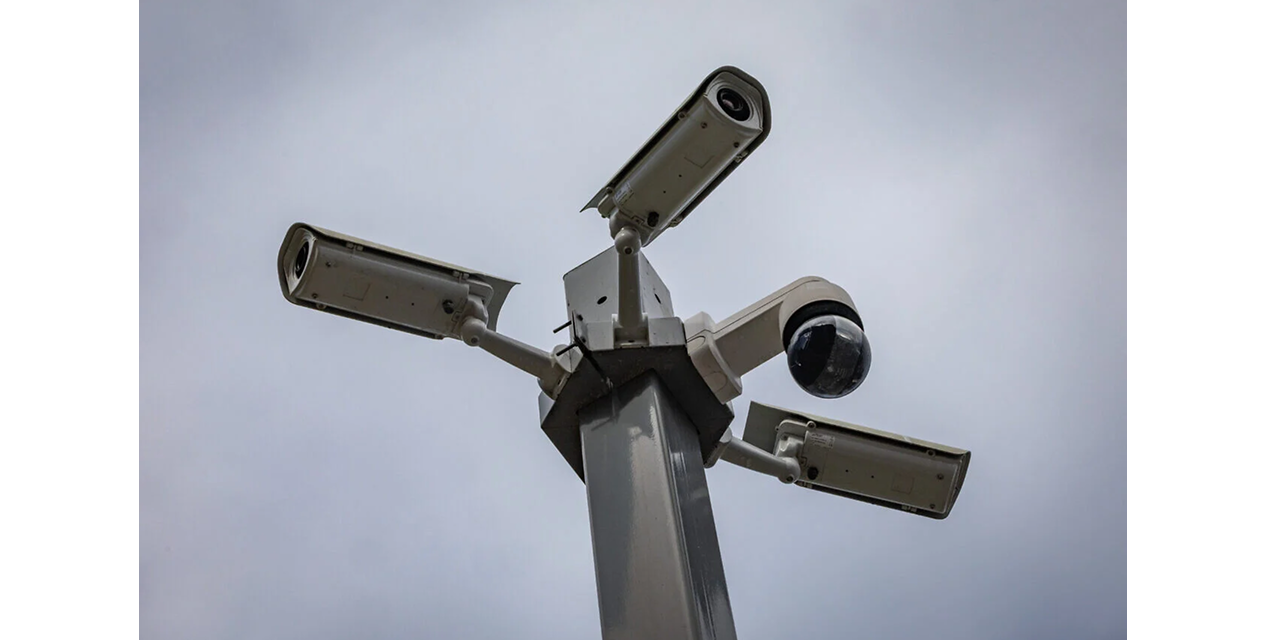
Security cameras on a pole in Jaffa, Feb. 3, 2026. Photo courtesy of Nati Shohat/Flash90. | Nati Shohat/Flash90
By ANDREW BERNARD
JNS
There is a substantial gap between the ways that American Jews and the general U.S. public perceive the threat of anti-Jewish bigotry, according to the American Jewish Committee’s new annual poll on the state of anti-Semitism in America. The survey, released on Tuesday, Feb. 10, found that nearly half of American Jews believe that anti-Semitism is a “very serious problem,” compared to only 28% of the general public.
Empathy?
Ted Deutch, CEO of the American Jewish Committee, told JNS that “America needs to wake up to the reality of what their Jewish neighbors are experiencing.”
A Fearful Community
“When the go-to response by those who are concerned about our community is more metal detectors and more bulletproof glass, they’re missing the impact that this is having, not just on our community but on our society as a whole,” Deutch said.
“Nearly a third of American Jews were the target of anti-Semitic incidents, and more than half of American Jews changed their behavior during the past year out of fear of anti-Semitism,” he told JNS. “That’s something that everyone should be mindful of, because its impact goes beyond the Jewish community to our broader society in America.”
AJC began doing side-by-side polls of American Jews and the wider national public about attitudes regarding anti-Semitism in 2020 in the wake of the 2018 Tree of Life synagogue shooting in Pittsburgh. The surveys have charted the growing fears among American Jews for safety—concerns that increased markedly after Oct. 7.
From 2022 to 2025, the percentage of American Jews that reported avoiding “publicly wearing, carrying or displaying things that might help people identify you as a Jew” nearly doubled from 23% to 41%.


The Next Event?
Some 91% of American Jews report feeling less safe than they did a year ago as a result of the arson attack on Pennsylvania Gov. Josh Shapiro’s residence in April, the killing of two Israeli embassy staffers at the Capital Jewish Museum in Washington in May and the firebombing at a demonstration calling for the release of hostages in Boulder, Colo., in June.
A former Democratic congressman from Florida, Deutch told JNS that American political leaders need to better understand that those attacks are not isolated incidents, but part of a consistent pattern of threats against Jews.
“We’re not facing a series of one-offs that surprise us time after time,” he said. “We have to get the broader community to understand that those events—and the murders in Manchester, the attack on Bondi beach and the firebombing of the synagogue in Jackson and all of the synagogues around the world that have been attacked and cemeteries that have been vandalized—that all of this goes together and that we can’t simply afford people to express some sympathy when something happens and then stop thinking about the problem.”
“If you’re not thinking about the problem and we’re not trying to address this, then it’s only a matter of time until the next event that is going to require more sympathy and more expressions of concern,” he said.
AJC polled 1,222 American Jews aged 18 and older between Sept. 26 and Oct. 29, 2025, and 1,033 members of the general American adult population from Oct. 3-5.
The survey found statistically significant demographic differences among Jews in the ways that different sectors of the community experience anti-Semitism.
More than half of Orthodox Jews (54%) report being the target of anti-Semitism in the past 12 months compared with 33% of Jews of any other denomination and 26% of secular Jews.
Young American Jews, aged 18-29, likewise report (47%) being the personal target of anti-Semitism in the past year much more frequently than older Jews (28%). Jewish women (35%) are somewhat more likely than Jewish men (28%) to report being subject to anti-Semitism in the past year.
Overall, 31% of American Jews say they were a target of an anti-Semitic incident, which AJC described in the poll as “a physical attack, a remark in person, anti-Semitic vandalism or messaging, anti-Semitic remark or post online or through social media, or any other form of anti-Semitism.”
Those figures have increased somewhat in recent years, with 26% of Jews reporting being the target of an anti-Semitic incident in 2022 and 25% in 2023. The 2026 finding is within the margin of error for the 33% who reported being the target of Jew-hatred in 2024.
Security Costs
The AJC polling is frequently cited alongside FBI hate crime statistics and data from the Anti-Defamation League to track threats against Jews in the United States, how those threats are perceived and to weigh policy responses.
The Jewish Federations of North America estimates that Jewish organizations spend some $765 million on security annually, and the federal government also spends tens of millions of dollars each year on security for Jewish institutions through programs like the U.S. Department of Homeland Security’s nonprofit security grant program.
Proud With Allies?
Despite the costly security efforts within the Jewish community and intense focus among Jewish groups to combat Jew-hatred, AJC found that 30% of Americans report being unsure what “anti-Semitism” means or having never heard the term at all.
Similar findings have raised questions about the efficacy of efforts from Jewish institutions to combat anti-Semitism, including the recent Super Bowl ad from New England Patriots owner Robert Kraft’s Blue Square Alliance Against Hate. The $15 million ad campaign prompted criticism among some Jewish commentators who objected to its depiction in front of the 125 million Americans who watch the Super Bowl of a bullied Jewish school child being comforted by a classmate with a blue post-it note after being called a “dirty Jew.”
Deutch told JNS that there need not be a choice between Jewish resilience and gaining support for Jews among the American public.
“Should the broader community stand up for the Jewish community? It should be a rhetorical question, but it isn’t,” he said. “The answer is, of course the broader community should stand up for the Jewish community and should stand up for all of us as proud Jews.”
“We need to be proud Jews and not cowards,” he added. “But this data that we’re talking about? There are a lot of proud Jews who feel very much at risk, and that’s what should concern America as a whole.”