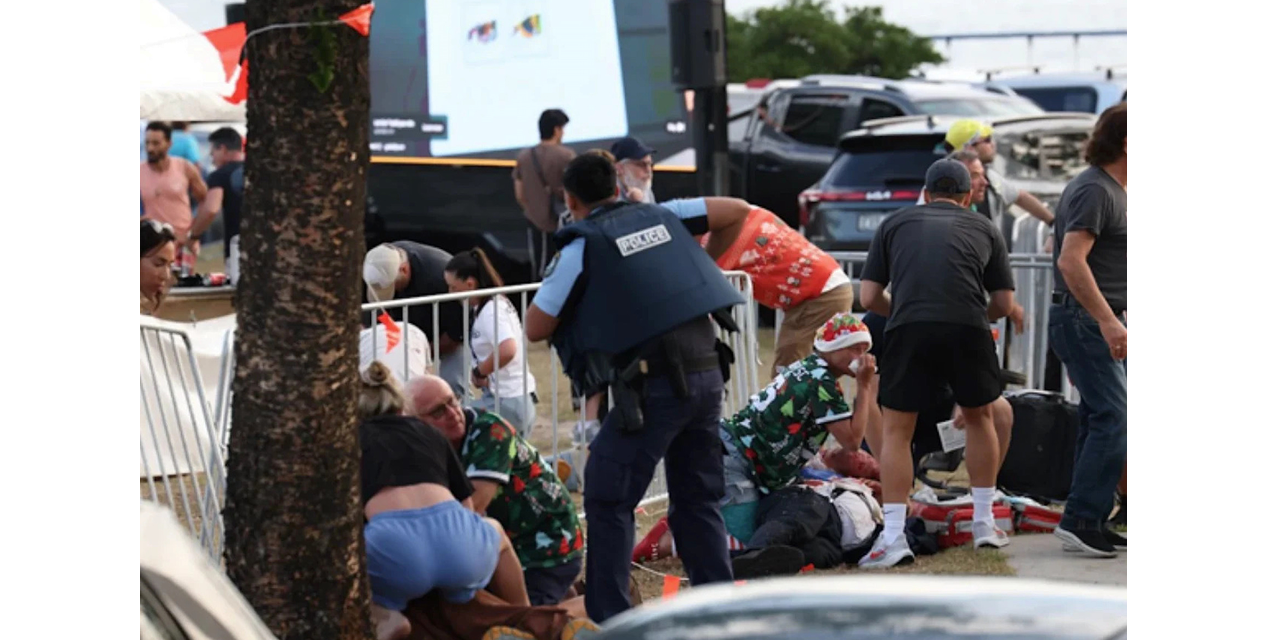
Ronny Krite, second from left, in flowered shirt, looks up while helping Geffen Bitton, an Israeli national living in Australia, as Nixy Krite in flowered shirt and hat, works to aid Reuven Morrison, a grandfather who placed himself in the line of fire to save others, while a woman, left, black T-shirt and blue shorts. also helps, after a mass shooting on Bondi Beach, Australia, during a “Chanukah by the Sea” event on Dec. 14, 2025. Bitton survived, but Morrison, who was born in the former Soviet Union but had made Australia his home, died that day. Credit: Courtesy.
By DEBORAH FINEBLUM
JNS
It’s been over six weeks since the mass shooting in Australia took place, but for those present that day, it feels both a lifetime ago and yesterday.
On the afternoon of Dec. 14, Ronny and Nixy Krite were anticipating having a pleasant time at the Christmas party at the Bondi Surf Bathers Life Saving Club, their two grown kids having made other plans that Sunday night. Many of their friends among the volunteer lifesavers would be there. By 5:30 p.m., the couple had finished conducting training with inflatable rescue boats and their beach patrol and had changed into their Christmas-tree shirts, Nixy into her Santa hat.
But instead, the next few hours would change their lives, and the lives of the hundreds of Jews celebrating at Archer Park next door. Altogether, 15 people were shot and killed at Sydney’s annual “Chanukah by the Sea” on this—the first night of the holiday—including the couple shot trying to disarm one of the shooters, two Chabad rabbis, a Holocaust survivor and a 10-year-old girl.
Disbelief
By 6:40 p.m., Ronny Krite was bringing his drink to the table when someone came in from the balcony yelling, “Everyone down! There’s a shoot-up!”
“You’ve got to understand—this kind of thing doesn’t happen in Australia, so I sort of laughed it off,” he recalls. “Then I heard what sounded like fireworks and other people saying, ‘Yeah, there’s a shooter.’ The first thing I did was grab my wife, and we managed to get some of the kids into the ladies’ room. When we came out, I saw some people drinking at the bar while others were ducking down under the window.”
Running to Help
Out the window, Krite noticed a policeman “holding his gun up like a shoot-’em-up movie behind the climbing walk on the playground.”

As gunshots continued to fill the air, the Krites ran toward the scene. “I saw a young woman bending over someone injured. It turned out to be Geffen [Bitton], the Israeli who’d been shot trying to save people, and all I could think of was ‘I have to do something for him.’ I ran over and tried to help a young woman who was working on him,” he says.
“I kept yelling at him: ‘Don’t close your eyes!’ I was trying to keep him conscious. But then I saw more blood coming out of his legs. I cut his pants off and found a wound. I’m yelling, ‘We need the trauma kit!’—we have equipment at the club—and a few members ran out of the club to help, all of us in our Christmas outfits. If you looked from a distance, you would have seen all these elves treating the wounded.”
Soon, Krite was answering the man’s ringing phone, saying, “He’s injured, and I need to know his name.”
“It’s my brother,” the woman on the other line said. “It’s Geffen.”
Unforgettable Scenes
Meanwhile, Nixy was working on Reuven Morrison, a grandfather who’d been shot trying to get the gun away from one of the terrorists. “I turned and gave her a look; I could see she was afraid, and I knew she was reflecting the fear in my eyes, too.”
The images he recalls of that terrible night are like snapshots: a gun lying on the ground nearby (“It looked like an elephant gun”), the unlit menorah, a big video screen still showing cartoons with singing and dancing, and a bunch of empty prams (strollers). “At that moment, Geffen was really passing out, and I saw my wife performing CPR on Reuven. I’ve seen her perform that before, but never with all that blood; we’re not medics, just volunteer lifesavers. All of a sudden, Geffen started screaming in pain, and we knew we had to get him to an ambulance immediately, so we carried him on a surfboard.”
Tears And Chaos
Looking back over his shoulder, Krite saw that Reuven, whom his wife had been working to revive, had died.“Nixy was weeping over him.
Then I saw Rabbi Eli [Schlanger] and thought that he could use more help, so I went over and held his head to help them defibrillate him and checked for other wounds. The paramedic said it was too late, and we should stop trying to resuscitate him, but no one wanted to stop. Then the paramedic turned to me and said, ‘It’s too late for him, but there are more people who still need your help.’ There was so much chaos—people yelling for more equipment, ambulances, paramedics. And so many tears.”
Krite then turned to help move an older woman onto a rescue board and into an ambulance. “She was in a terrible amount of pain, and when an older woman is in pain, it just sounds different,” says Krite. “When she was on the board, she suddenly stopped screaming, and I knew she was gone.”
“By the time I got back to Nix, she was still standing over Reuven. Nix isn’t Jewish, though I am, but she knows the Jewish tradition that when someone dies, you can’t leave them alone,” says Krite. “There were six or eight other bodies in the park with sheets over them, but she refused to leave Reuven until the policeman promised not to leave him alone.”
After the last ambulances had left with the wounded, the Krites walked back to the club. There, they found police collecting statements from some of the other lifesavers. They went into the bathroom to wash off the blood before calling their daughter to pick them up outside the roped-off area.
“At that point,” he says, “what we were feeling was numb.”
‘People Came Together’
This year, the Or family didn’t attend their usual first-night event: Chabad’s menorah-lighting and Chanukah party at Bondi Beach. They opted to light the menorah with an elderly aunt.
“We were sitting at dinner when my son, Idan, brought me my phone, and I said, ‘No, thanks. I just want to enjoy dinner.’ But he said, ‘Ima, you have to look at all these messages you’re getting.’ And, yes, there were so many messages that said, ‘We need you at the beach now. There’s been a shooting,’” says Or, a 49-year-old registered nurse and member of Community Health Support, a volunteer emergency-response team.
Quick Response
Within minutes, she was at the beach, pulling her first-aid gear and portable oxygen machine out of the car. Skirting around the taped areas, Or encountered a woman bleeding from a minor forehead wound (“She could still talk, so I told her she’d be OK”) and two bodies. But seeing they were already covered with sheets, she moved on.
“Suddenly, a bystander rushed at me and said, ‘You have oxygen?’ We ran together and arrived at this crazy scene. It was probably 7:10. The shooting had stopped by then (and one of the terrorists, Sajid Akran, had been killed by law enforcement, and his son, Naveed, injured and taken to the hospital. He is now in police custody with dozens of charges pending.)
Or could see 20 or so injured people on the ground being evaluated and treated, while the dead remained scattered about, covered with sheets. “One man—I think it was Rabbi Schlanger—they were trying to resuscitate him, and they kept trying and trying. I ran around from person to person, seeing what I could do—mostly packing wounds and checking vitals for internal bleeding, anything I could think of that could help until they could get them to the hospital.”
Child Protects Kids
One of them was 14-year-old Chaya Mushka Dadon, who’d emerged from her hiding spot under a bench when she heard an injured mom calling out, “Please, someone save my kids!” and jumped onto the two children. “She took a bullet in her leg but saved the children, and I was monitoring and comforting her,” recalls Or. “I realized that the seriously injured were already being treated, including little Matilda. There were doctors in the neighborhood who appeared from nowhere—the surf lifesavers and rescue people, plus so many random bystanders. People did amazing things that night.”
So many owe their lives to the responders, she adds, “and to those who protected their loved ones and those around them. There was chaos and there was carnage, but people came together in amazing ways, both from the Jewish community and the larger community beyond.”
New Fear
“I know there are a lot of our clubbies that this has really hit hard—so much blood, so much death, so much mess and noise and chaos,” says Krite. “But for me, the biggest thing is that this has happened here in Australia, and in Bondi, where I was born and went to school and never once in my 55 years experienced anti-Semitism.
“You’d probably call me a Jew who loves hamantaschen and Chanukah and the Pesach seder and Shabbat dinner, but I never walk out of the house with my kippah on. I’m just not that religious,” says Krite. “But this incident, yes, it has made me feel more Jewish but also more afraid.”
Though his daughter proudly wears her Magen David, and his dad does as well, while his non-Jewish stepmom displays a chai around her neck, Krite himself admits to feeling “scared as a Jew.”
“It’s still very raw. I’m not a crier, and I don’t really consider myself a people person—I’m a software developer for God’s sake—but I’ve cried more in the past five weeks than in my whole life. Was I meant to be there? Though my father insists it was fate, bashert, that I was there, and it’s a message for us to be proud Jews, I don’t like to think so, but I just don’t know.”
Time To Pay Attention
“We’re shocked, but not surprised,” says Or, echoing a sentiment that’s ricocheted around Sydney’s Jewish community since Dec. 14. “The writing’s been on the wall here for two years with calls for global intifada, posters of hostages ripped down, firebombs thrown at synagogues and cars, and even a daycare center next to the shul (they made a mistake and bombed the wrong building), plus so much hate in public and online.”
In September, Australian Prime Minister Anthony Albanese unilaterally declared that the country recognized Palestinian statehood, along with France, Canada and the United Kingdom—effectively pouring gas on simmering coals.
“We haven’t had a terrorist attack here for 30 years, but now, we have—targeting not Israel but all Jews. And we need to pay attention,” says Or.
“There certainly are those who are now more afraid of being visibly Jewish, but I’d say most of us feel that we’re not going to hide and stop what we’ve been doing for decades. We’ll carry on as proud Jews and expect the authorities to protect us.”
More men are wearing kippahs, she notes, and Or reports that this Chanukah, even non-Jews put candles in their windows in solidarity.
As for Or herself, more than a month later, she reports that “she’s doing pretty well, generally, though I debriefed with a friend the other day and, just reliving it, I didn’t sleep well that night.”
But on Dec. 14, as gunshots rang out over Bondi Beach, the menorah remained dark; the attack occurred just before sundown when it was scheduled to be lit. But on ground zero of this massacre, within days of the killings—and amid the floral bouquets, yahrzeit candles, piles of memorial stones and Teddy bears—there was a Star of David bearing the words “Jewish Lives Matter.”
“We’ve heard about anti-Semitism around the world, but thought there was nothing to worry about here,” says Krite. “But the fact is, it has happened here, and the people who were targeted are my people.”
“There are no excuses anymore,” stresses Or. “Because now everyone needs to wake up to the fact that hate speech always leads to hate action. And it must be stopped.”