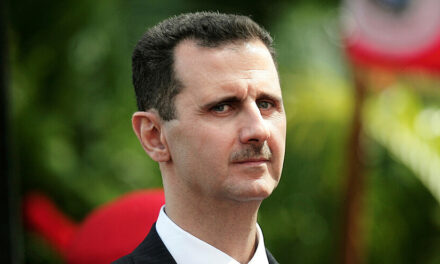
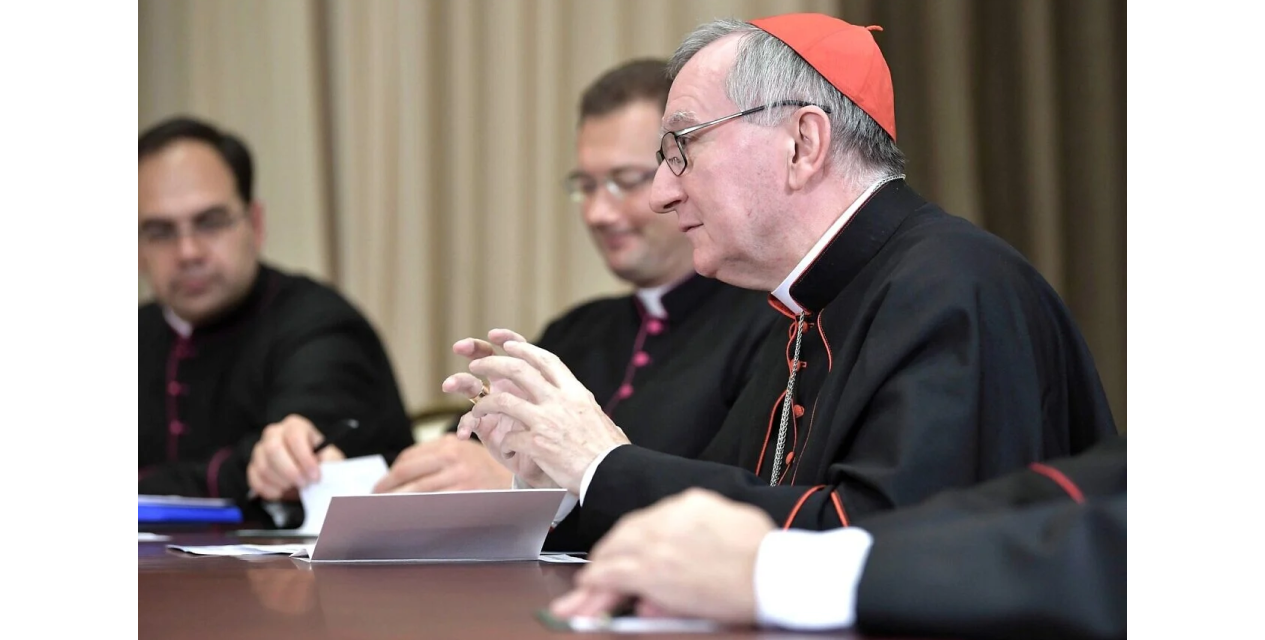
Cardinal Pietro Parolin speaking during a meeting with Russian President Vladimir Putin in Sochi, Aug. 30, 2017. Photo courtesy of Kremlin via Wikimedia Commons.
By MIKE WAGENHEIM
JNS
The Holy See, the central governing authority and diplomatic representative of the Roman Catholic Church, will decline U.S. President Donald Trump’s invitation to join the Board of Peace, citing the body’s “particular nature,” according to Cardinal Pietro Parolin, the Vatican’s secretary of state.
Not The Church’s Task?
Cardinal Pierbattista Pizzaballa, the Latin patriarch of Jerusalem, offered a sharper critique, describing the U.S.-led body overseeing the processes of the Gaza peace plan, including the dismantling of Hamas, as “a colonialist operation—others deciding for the Palestinians,” according to a report by Italian daily Il Sole 24 Ore.
Pizzaballa also derided the $1 billion fee for a permanent seat on the Trump-chaired Board of Peace. “I’ve never had a billion [dollars], but above all, this is not the Church’s task,” he stated. “It is the sacraments, the dignity of the person.”
In January, Parolin said that Pope Leo XIV, who is American-born, was reviewing Trump’s invitation and that a response would take time. He stressed at the time that any reply “will not be to participate financially,” noting that the Vatican was “not in a position to do so.”
Little Accountability
On Tuesday, Feb. 17, Parolin underscored the Holy See’s view that the United Nations should remain the primary body responsible for managing global affairs. “At the international level, it is above all the U.N. that manages these crisis situations,” Parolin stated. “This is one of the points on which we have insisted.”
The U.N. Security Council granted the Board of Peace a mandate in November focused specifically on Gaza, running through 2027. Critics argue that language in the board’s charter allows room for the board to delve into other conflicts and ultimately puts Trump in charge for as long as he wants, with little accountability.

The board is set to host an inaugural meeting in Washington, D.C., on Thursday, Feb. 19.
The White House has announced that 22 countries have signed the founding charter since Trump launched the initiative at the World Economic Forum in Davos, Switzerland, in January. Six additional states have signaled their intent to join.
Fourteen countries have publicly declined invitations, while 15 others have yet to respond. Several European governments have expressed concern that the initiative could sideline the United Nations.
Six countries, plus the European Union, will attend as observers.
Oman’s foreign minister has announced plans to attend, though it’s unclear under what status. Israel, which signed on to the charter is sending Foreign Minister Gideon Sa’ar.