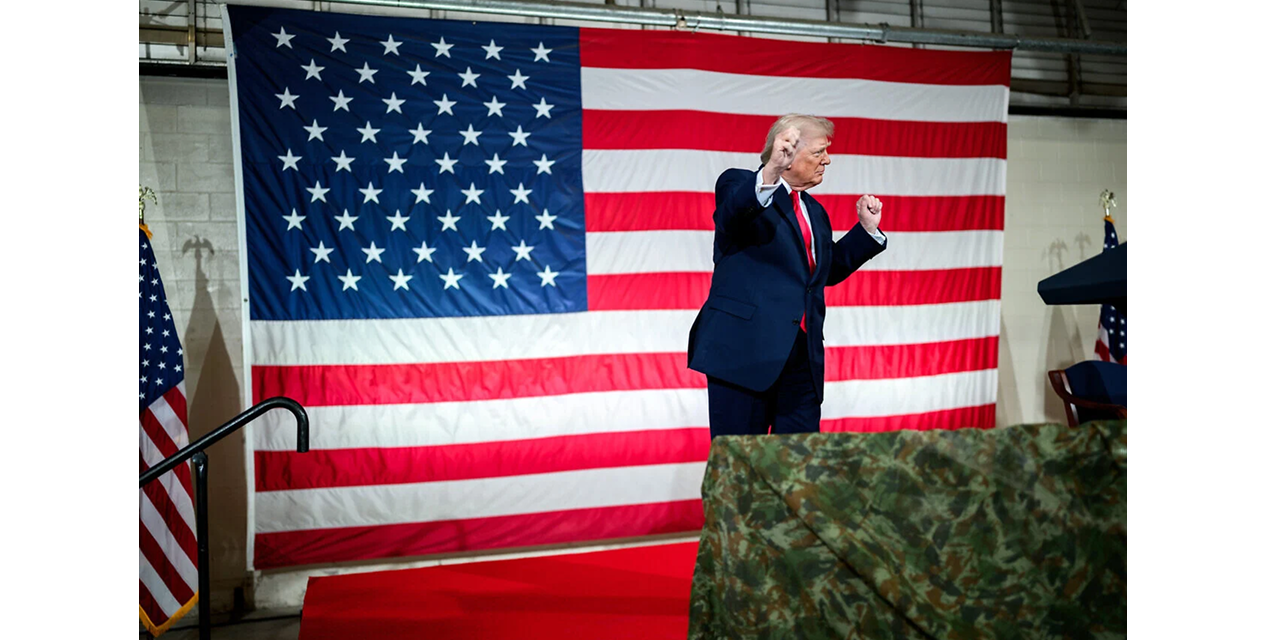
US. President Donald Trump delivers remarks to military families at Fort Bragg, N.C., Feb. 13, 2026. Photo courtesy of Daniel Torok/White House.
By MITCHELL BARD
U.S. President Donald Trump touts the 2020 Abraham Accords as his foreign-policy achievement and criticizes former President Joe Biden for not expanding them. But so far in his second term, Trump is batting .000. He has not built on the accords beyond the largely symbolic case of the non-Middle Eastern country of Kazakhstan. He squandered the clearest opportunity of all: finishing the Saudi deal that Biden left on the table.
Riyadh has Moved On!
Trump entered office with maximum leverage over Riyadh. The Saudis desperately wanted a U.S. security guarantee, advanced arms and nuclear technology. Trump could have demanded normalization with Israel as the price of admission. Instead, he whiffed, giving away the leverage and choosing to sacrifice Israel for the promise of a trillion dollars in Saudi investments in the United States.
Riyadh has now moved on, distracted by domestic economic troubles and falling revenues. As the window narrows, the biggest prize in Arab-Israeli diplomacy remains unclaimed.
What about Trump’s other Gulf “friends”?
Questions About Qatar
Has he ever raised normalization with Qatar?
Trump calls the emir “one of the great rulers of the world.” He praises Qatar as a “very good ally.” He applauds its role in hostage negotiations. He even handed Doha a security guarantee without the inconvenience of a treaty requiring Senate approval.


Yet no one in the White House seems willing to say aloud what makes Qatari normalization impossible: Qatar bankrolls Hamas, promotes radical Islam and traffics in anti-Semitism. Jared Kushner, the president’s son-in-law and the real architect of the accords, surely knows that. Trump simply prefers not to mention it.
And what about Kuwait?
Kuwait has no territorial dispute with Israel. This Gulf state would likely be part of Iraq today if not for the United States. So, we should have leverage over the Kuwaitis. And yet, they remain one of the most stubborn holdouts against normalization.
Where is the pressure? Where is diplomacy? Where is the Trump deal-making?
Challenges With Syria, Lebanon
Then there is Trump’s newest “friend”: the radical Islamist militant who is now running Syria. Trump lavished praise on Ahmed al-Sharaa, brushing aside his jihadist record as merely a “rough past.” While he signaled interest in brokering ties with Israel, he once again gave away the advantage by lifting sanctions on Syria without extracting a commitment to join the Abraham Accords.
Lebanon presents yet another challenge.
A new president, billed as a moderate, has taken office in Lebanon, and the United States continues to prop up the Lebanese army—another potential pressure point for American diplomacy. But the army is weak and penetrated by Hezbollah. The president has pledged to disarm the militia, yet Hezbollah has no intention of surrendering its arsenal, and any serious attempt to confront it risks plunging Lebanon back into civil war. Until Hezbollah is disarmed, Lebanon cannot reclaim its sovereignty, and peace with Israel remains impossible.
Do we hear Trump pushing normalization there?
Silence.
The president promised peace in the Middle East, essentially declaring victory after forcing Israel into ceasefires with Hamas, Hezbollah and Iran before Israel achieved its war aims.
But ceasefires are not even normalization. They do not correlate to peace.
Dismantling Hamas
Israel is still fighting in the Gaza Strip. Trump’s peace plan called for an “International Stabilization Force,” but no country wants responsibility for dismantling Hamas. The terrorist organization insists that it will never disarm and is rebuilding across 47% of Gaza, which it still controls.
The war never truly ended and is likely to intensify again as Israel redeploys to finish the job left incomplete after two years of fighting.
Lebanon is no different.
Israel continues to strike Hezbollah operatives and infrastructure daily in Southern Lebanon. But before the ceasefire, most of the group’s fighters, including its elite Radwan force, simply withdrew north of the Litani River, beyond Israel’s immediate reach. From there, Hezbollah is rebuilding with Iranian funding and weapons smuggled through Syria. With little chance that the Lebanese government will ever disarm the militia, the likely outcome is that Israel will be forced into a full-scale campaign to eliminate the terror threat to its northern border.
Iran’s Strategy
Which brings us to Iran, the central front.
Israel fears that Trump is desperate for a deal, eager to declare success while avoiding military confrontation. The danger is obvious: another porous agreement, as hollow as former President Barack Obama’s, leaving Iran’s nuclear infrastructure intact. Tehran has already rejected Israel’s core conditions: no end to enrichment, no surrender of stockpiles, no halt to missile development, no abandonment of terror proxies.
Iran’s strategy is simple: drag out negotiations.
Why The Wait?
Trump says he will not wait long, and it is hard to believe that the United States sent two aircraft carriers and a massive strike posture to the region without planning on using them. If the president attacks Iran, he can forget the Nobel Peace Prize dreams. Oslo does not reward wars. He’ll have to be satisfied with the prize he received as a gift.
Paradoxically, however, war with Iran may be the only event powerful enough to reshape the region. Still, the outcome is uncertain. Regime change would require a true home run—something Trump, until recently, opposed. Anything less leaves Iran wounded but dangerous.
If the regime falls and a pro-Western Iran emerges, then peace between Israel and Iran is conceivable. The two countries had decades of cooperation before 1979. Additionally, the Shi’ite-Sunni cold war would cool. Gulf States would breathe easier. Without Iran’s patronage, Hezbollah would weaken. Lebanon might reclaim its independence.
Hamas would be further isolated by an Iranian defeat. But Trump’s dream of turning Gaza into the “Monte Carlo of the Middle East” remains delusional unless Hamas is annihilated—not managed, not contained, but destroyed.
Trump once delivered a diplomatic breakthrough and the promise of regional peace. Now, as the region veers toward war and opportunities are lost, his failures stand in stark contrast to his past boasts. The Middle East is edging closer to chaos, and Trump’s legacy risks being defined not by peace, but by missed chances and mounting instability.