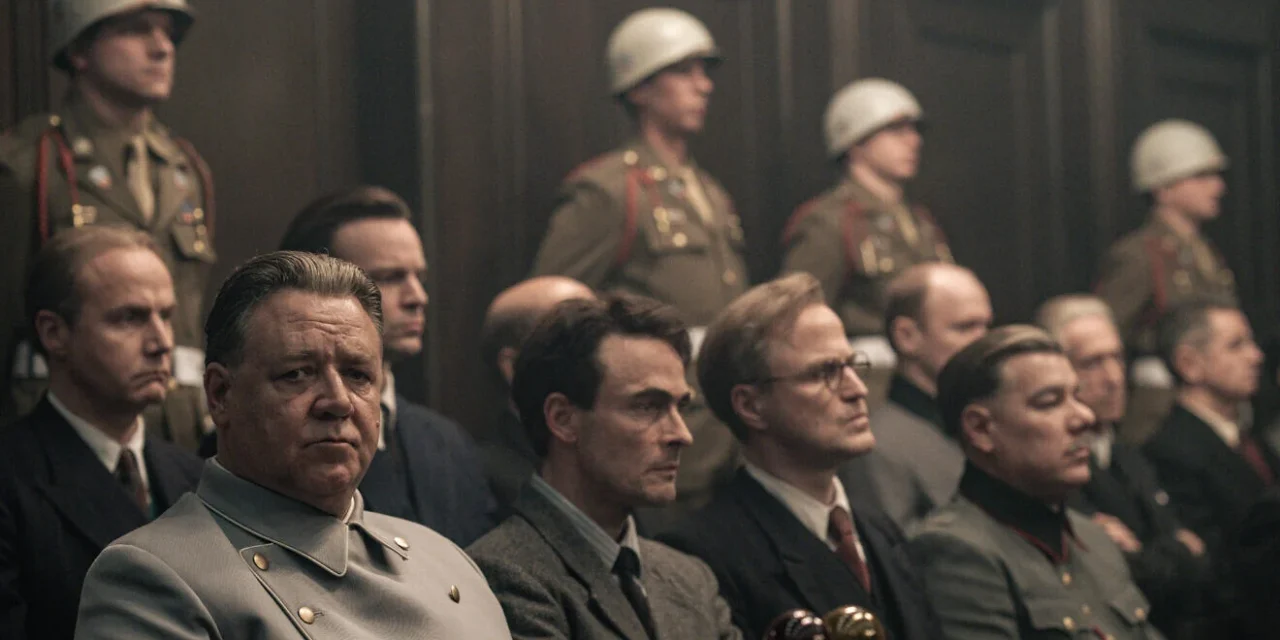
Russell Crowe as Hermann Göering in the 2025 film “Nuremberg.” Credit: Scott Garfield/Courtesy of Sony Pictures Classics.
By MITCHELL BARD
JNS
The most powerful scene in the 2025 film “Nuremberg” occurs when the prosecution shows documentary footage from the liberation of Nazi concentration camps. Amid the image of unspeakable horror, a calm voice describes how prisoners were murdered at Mauthausen in Austria. The speaker is an American GI who survived the camp.
Lt. Jack Taylor was an experienced agent of the Office of Strategic Services, the wartime precursor to the CIA. In late 1944, he parachuted into Austria to lead a mission code-named “Dupont,” intended to gather intelligence on German troop movements near the Hungarian border. The mission quickly fell apart when his team’s radio was lost. “Our mission seemed doomed to failure from the start,” Taylor later said.
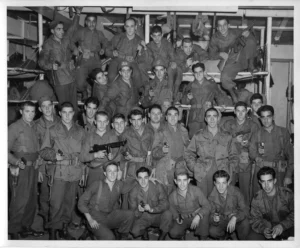
Troops in their quarters aboard HR-622, southside of Pier 6, sailed overseas under the command of Capt. Robert R. Rovzar, Jan. 1, 1944. Official Photograph courtesy of U.S. Army Signal Corps, Hampton Roads Port of Embarkation, Newport News, VA.
His New Life
Captured by the Gestapo on Dec. 1, 1944, Taylor spent weeks in solitary confinement before being transferred to Mauthausen, where he saw “half-dead creatures in filthy, ragged stripes and heavy wooden shoes.”
Taylor’s interrogation began immediately. For three hours, three SS men beat him in relays, shouting “You American swine!” with each blow. He was stripped, shaved and given a ragged uniform. Survival depended on theft and cunning. “Stealing was a matter of life and death,” he said.


Crematorium
Taylor was assigned to help build a new crematorium. “We dawdled at our work to delay completion of the crematorium,” Taylor said. The SS then ordered the work finished in 24 hours, or the workers would be the first occupants of the new ovens. “Needless to say,” recalled Taylor, “we finished the job in the allotted time.” The next day, 367 new prisoners, including 40 women, were marched straight to the gas chamber before christening the new ovens.
“Black oily smoke and flames shot out of the top of the stacks as healthy flesh and fat was burned as compared to the normal pale-yellow smoke from old, emaciated prisoners,” recalled Taylor. “This yellow smoke and heavy sickening smell of flesh and hair was blown over our barrack 24 hours a day, and as hungry as we were, we could not always eat.”
Other Jobs
Taylor was next forced to carry 110-pound soup kettles to feed a camp of nearly 20,000 Hungarian Jews. “I received several bad beatings because I could not support the weight,” he said. “When afforded an opportunity, we dipped our ever-handy spoons under the lids and managed several mouthfuls of extra soup.”
Later, he was ordered to haul stones for roadwork and to dig gardens beside the barracks. Weakened by dysentery and fever, he lost more than 50 pounds. He feared going to the infirmary because he knew few people returned alive from this “hospital.”‘
Eyewitness Accounts
Fellow prisoners saw his presence as a sign of hope. “If you live, it will be a very fortunate thing,” they told him. “You can tell Americans, and they will believe you. But if we try to tell them, they will say it is propaganda.”
Taylor listened to hundreds of eyewitness accounts of atrocities. Prisoners were beaten, drowned, torn apart by dogs, injected with poison, forced over a cliff, driven into the electric fence and frozen to death. Others were subjected to medical experiments or executed for minor deformities or tattoos. “I had seen only a small percentage of the torture, brutality and murder,” Taylor said. “But I was prepared to believe their stories 100%.”
Rumors spread in the spring of 1945 that the SS planned to exterminate the sick to erase evidence of their crimes. Taylor feared the entire camp would be liquidated before the Allies arrived.
On May 5, 1945, Sgt. Albert J. Kosiek and a small reconnaissance unit stumbled upon Mauthausen without knowing what it was. “I could only say ‘God Bless America’ and hold out my dog tags with a quavering hand,” Taylor recalled after surviving six weeks in the camp.
Key Witness
Though gravely ill, Taylor insisted on remaining to help investigators. He located documents and witnesses that would later prove crucial in prosecuting Nazi officers for war crimes. He also discovered that he had been slated to be executed on April 28, but a Czech prisoner had secretly destroyed his file.
Despite his distinguished OSS record and the ordeal he had lived through, Taylor was initially suspected of being a double agent after his liberation. Later, he proved to be a key witness in the trial of Nazis responsible for Mauthausen and testified that he was not the only American held in the camp. Sixty-one Nazi officials were tried on charges of war crimes. Fifty-eight were sentenced to death; three were given life sentences. Later, nine of the death sentences were commuted to life imprisonment.
Taylor died in a plane crash in the United States in 1959 at the age of 50. His OSS files were not declassified until after his death.
He is just one of many American victims of the Holocaust whose story is largely unknown. Fortunately, the documentary evidence survived, ensuring that this hero is not forgotten.