
The opening ceremony of the 2024 JCC Maccabi Games in Detroit, July 28, 2024. Photo courtesy of the JCC.
By DAVID WISEMAN
JNS
At a time when Jewish identity around the world—especially in the United States—has been challenged more than ever, the 43rd JCC Maccabi Games come at a very welcome time.
Ever since they were first hosted by the hosted by Jewish Community Center Association of North America in Memphis, Tennessee, in 1982, the JCC Games have become a staple of Jewish teen life. This year, some 3,000 Jewish teen athletes are set to converge on Tucson, Arizona, and Pittsburgh, Pennsylvania, for the largest Jewish youth sports event in the world.
The 2025 JCC Maccabi Games are scheduled for Tucson from July 27 to Aug. 1 and in Pittsburgh from Aug. 3 to 8.
This year’s edition will be different for two reasons. First, at Tucson, they are rolling out JCC Maccabi Access for athletes with intellectual and developmental disabilities, which offers them the ability to participate in competition. Meanwhile, in Pittsburgh, they are introducing the JCC Maccabi Campus Games, where the athletes will be housed in an Olympic village-type setting at the University of Pittsburgh.


Resilience
Samantha Cohen, senior vice president and continental director of JCC Maccabi, oversees the Games. “Gathering in celebration with more than 3,000 Jewish teens and coaches and thousands more spectators, volunteers and community members at the JCC Maccabi Games this summer is a powerful testament to the vitality of Jewish life—and the resilience of the Jewish people,” Cohen told JNS.
Cohen herself was bitten by the JCC bug. She grew up in London, England, and was a member of the Great Britain tennis team at the 2000 JCC Games on Staten Island. “I was at the opening ceremony in Madison Square Garden and sang Hatikvah together with thousands of Jews. It was a life-changing experience, and then and there I knew I wanted to make it my life,” she said.
Cohen did—rising through the ranks as coach, delegation head, director, and now continental director, where she runs the whole Games and sits in an office just a block away from Madison Square Garden.
Jewish Identity
The JCC Maccabi Campus model is designed both to accommodate the growing demand for participation and to provide teens with a powerful entry point to Jewish identity and campus community as they look ahead to higher education.
“The launch of our first-ever Campus Games marks a bold and timely evolution for the movement, showing Jewish teens what’s possible when they come together with pride, purpose and shared identity for a positive college campus-based experience. Today, when Jewish connection and unity are more important than ever, JCC Maccabi gives teens a joyful, formative experience that will stay with them for life.”
This year’s Games also feature the largest-ever delegation of Israeli participants, with 100 teen athletes and coaches traveling from communities across Israel. “We will have teens from the Gaza Envelope and northern Israel who were directly impacted by or displaced following the Oct. 7 attacks. In addition, athletes representing Bat Yam, Ramat Gan and Kiryat Ono—areas recently affected by Iranian missile strikes—will participate in the Games,” Cohen said.
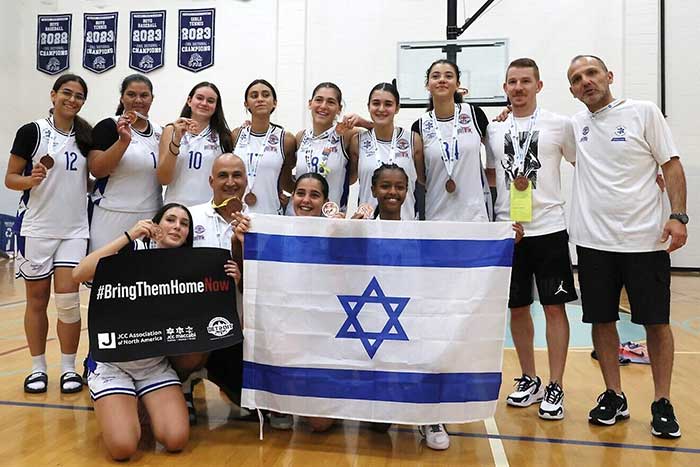
The Israeli girls basketball team at the 2024 JCC Maccabi Games. Photo courtesy of the JCC.
Best of the West
The Games kick off in Tucson with around 850 athletes from 41 delegations and not only mark the 25th anniversary of Tucson’s inaugural hosting of the Games, but also the 70th anniversary of the Tucson JCC itself.
For Tucson JCC president and CEO Todd Rockoff, said,“Hosting the JCC Maccabi Games and Access embodies our enduring commitment to Jewish values and community-building, while providing an extraordinary opportunity to engage with Jewish teens—the very foundation and future of Jewish continuity. What it means to us is not just the experience of hosting the Games, but what it’s really meant to bring the community together for something really positive.
Rockoff is hoping for greater engagement from both youth and adults following the Games. Tucson has a delegation of 75 athletes and for many of them, this isn’t just their first interaction with Jewish youth activities—it’s their first exposure to the Jewish community, period.
Interconnectivity of Jewish life is a very important plank of the JCC, and to that end, Tucson will welcomes Jewish athletes from Moldova.
“This is the culmination of a year-long partnership with the Jewish community in Chișinău (formerly Kishinev), Moldova. We have four kids coming from there and can’t wait to welcome them,” Rockoff said.
More Than Just Sport
For Jason Kunzman, president and CEO of the Jewish Community Center of Greater Pittsburgh, hosting the Games comes with an extra layer of meaning. It has been almost seven years since the Tree of Life synagogue shooting, he noted.
“It’s wonderful for our community to come together for something so wonderful after having come together in recent times for events that weren’t as joyous,” he said. “We have an opportunity, given our recent history, to make a very powerful statement. This is a town, this is a region that embraces all people. We are inclusive. We are neighbors, and the Maccabi Games are the most explicit demonstration of Jewish peoplehood that there is.”
He said the opening ceremony will not only honor the victims of the Tree of Life terrorist attack, but also the victims of the 1972 Munich Olympics as well as the victims of Oct. 7, 2023.
According to Kunzman, the Games are a watershed event that can reinvigorate the community like nothing else can. “Our data reveals\ that 64% of teens aren’t involved in any Jewish youth program and less than a third are in Jewish day school,” he said. “Sport is the gateway for bringing them into the fold of formal Jewish communal life. Many of the athletes here will become the backbone of the next generation of leadership within our community.”
As Kunzman attested, the JCC Games are much more than simply being about sport. “It is about engaging people and activating the community to build a stronger and more inclusive Jewish future,” he said.
According to the Pittsburgh Games organizers as quoted in the Pittsburgh Jewish Chronicle, the games can foster peer connections and greater ties to the Jewish state. The hope comes on the heels of data released in June by Pew Research Center that “younger people are more likely than older people to have an unfavorable view of Israel.”