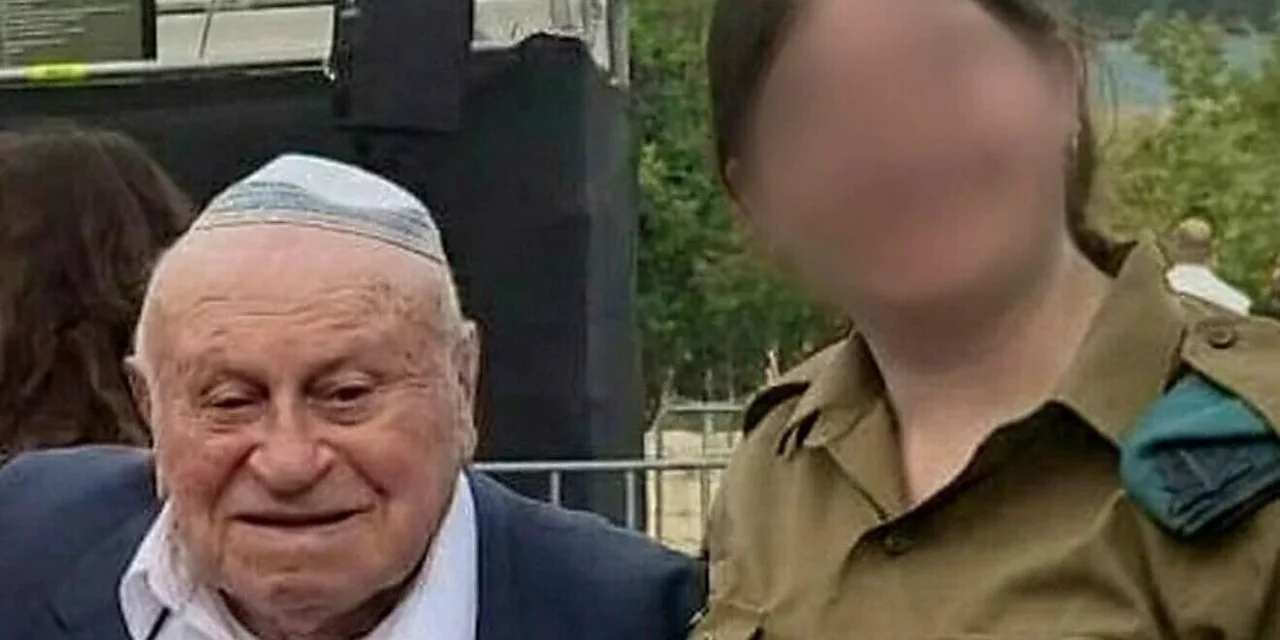
Holocaust survivor Arie Reiter, left, and his granddaughter, IDF Sgt. A. (face blurred for security reasons), Jan. 26, 2026. Credit: Courtesy.
By YAAKOV LAPPIN
JNS
In 1944, a teenage Jewish boy named Arie Reiter was sent to a forced labor camp to pave roads for the retreating German and Romanian armies.
More than 80 years later, his 22-year-old granddaughter, Sgt. A., serves as a commander in the IDF’s School for Computer Professions (known by its Hebrew acronym, Basmach), protecting the digital infrastructure of the Jewish state. This state, Reiter said, seemed like a surreal fantasy in the camps of Europe during those darkest of days.
Their shared story, told ahead of International Holocaust Remembrance Day on Tuesday, Jan. 27, encapsulates the arc of Jewish history in the modern era, from history’s worst and industrial genocide against a scattered people, to national self-determination and rebuilding.
“If I would have stood up when in the camp, and told people that we’d have a country, a military, that we’d have children and grandchildren as officers, that we’d have the best air force in the world, they would have wanted to put me in an insane asylum, Reiter, who was born in the Romanian city of Vaslui, told JNS on Monday.
Vivid Memories
For Reiter, now 97 and a resident of Beersheva since 1951, the memories of his childhood under the fascist Romanian regime in the Second World War remain vivid and brutally painful. Romania, under the leadership of Ion Antonescu, allied with Hitler, adopting the Nuremberg Laws and participating in the invasion of the Soviet Union.
“All the laws that the fascists, the Germans invented, were also in Romania,” Reiter said. “They expelled all Jews from universities, high schools, and schools. Jewish lawyers couldn’t represent Romanians. Jewish doctors couldn’t treat Romanians.”


Reiter’s father was taken to a forced labor camp in1939 and perished in May 1942. Left alone with his mother and two younger brothers, Reiter, then just 13, became the head of the household. The family owned a small shop and restaurant, but discriminatory laws forced them to take on a Christian neighbor as a partner, and to list him as the owner, to maintain their license to sell alcohol.
“When the war started, the partner said, ‘The restaurant is mine. I have the license,” Reiter recalled. “He put a lock on the shop entrance and on our bedrooms, which were adjacent to the shop. For six months, we went in and out through the window, just to drink.”
Stripped of their livelihood and basic rights, as Jews were forbidden from using public transportation and allowed in the market for only one hour a day, the family fled to a small room on the outskirts of the city. Reiter worked odd jobs to scrape together money for food, which was scarce as supplies were diverted to the war effort.
“I worked and brought food. There was almost nothing to eat,” he recalled. “Fish and meat were non-existent.”
In 1944, half a year before the war ended in Romania, the 15-year-old Reiter was conscripted into forced labor. He described breaking stones with hammers to create gravel for roads and building a wooden bridge with heavy logs. Decades later, during a roots trip with his grandchildren, he returned to that same bridge.
“I asked one of the residents in the village, ‘Tell me, who built this bridge?’ He said, ‘Yes, Jewish children built this.’”
Building A New Life
Following the war, Reiter became an ardent Zionist, joining the Bnei Akiva movement and eventually serving as the secretary of his local branch. While his brothers made aliyah in 1947, spending time in British detention camps in Cyprus before reaching Israel, Reiter remained behind to keep the youth movement running until he could immigrate to Israel in 1951. His mother had arrived in Israel a year before.
In Israel, Reiter built a new life. He completed his matriculation, worked for the National Religious Party and worked his way up to becoming the first manager of the Mizrahi Bank branch in Beersheva, a bank he worked at for 40 years.
He also dedicated himself to public service, initiating the construction of the Struma Synagogue in memory of the Jews who drowned on the Struma refugee ship in 1942, and establishing a museum on its second floor.
Today, Reiter is the patriarch of a large family, including 14 grandchildren who all serve or have served in the IDF.
Looking back on the history of modern Israel, Reiter said, “It’s a miracle. We see the miracle.”
Legacy In The IDF
His granddaughter, Sgt. A., carries this legacy with a profound sense of responsibility. As a team leader in the DevOps and Cyber course at the IDF School for Computer Professions, she is responsible for ensuring the security and continuity of the military’s training infrastructure.
“Grandpa and also my parents, and generally all the grandchildren, were educated to have a meaningful and Zionist service, and to understand that the fact that receiving the right to live in Israel is not to be taken for granted,” Sgt. A. said.
She recalled the family’s roots trip to Romania, where they visited the bridge her grandfather was forced to build.
“It was really, really meaningful for the fact that now we are in the IDF and we have the state,” she said. “Grandpa always reminds us of this.”
Technology Frontier
In her role, Sgt. A. oversees cyber soldiers who protect the unit’s networks from attacks, ensuring that the training of Israel’s future technological warriors continues uninterrupted.
She noted that her unit is constantly adapting to new threats and integrating new technologies, including Artificial Intelligence, into their curriculum and operational systems.
“We are now building a model where trainees will also use AI,” said Sgt A. “We will want to introduce this into the training as well.”
For Reiter, seeing his granddaughter serve, contributing to the security of the Jewish state, is the ultimate victory. He described how his other grandchildren serve across the IDF’s branches, with one in the Navy, another in the Air Force, another in the Armored Corps, and noted that even the younger generation is already preparing for their service.
Voice for Remembrance
Reiter remains an active voice for remembrance. He was chosen to light a torch at Yad Vashem and continues to speak to soldiers and students. He recounted a speech he gave last year to 3,000 students at Ben-Gurion University, where he pointed to his grandchildren in the audience as evidence that Israel will overcome its current wars.
“The president of the university told me it was the first time people clapped when someone spoke on Holocaust Day.”
Reiter’s message to the younger generation is one of vigilance and gratitude. He warns against taking the existence of Israel for granted. “We have no other country,” he said.
As Israel marked International Holocaust Remembrance Day, it was noted the population of survivors is dwindling. According to data from the Israeli Welfare and Social Affairs Ministry, approximately 111,000 Holocaust survivors currently live in Israel.
“Thank God, I lived through the exile, and … thank God, the revival,” Reiter concluded.