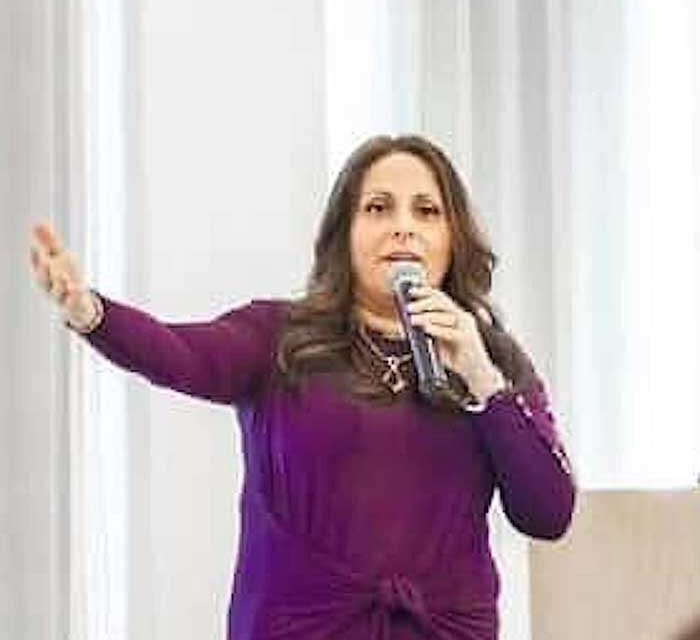
Matchmaker Aleeza Ben Shalom addresses participants at an international matchmaking conference in Jerusalem, January 2025. Photo courtesy of Jamie Gordon Photography.
By EVE GLOVER
JNS
Tu B’Av, the Jewish Day of Love, is celebrated on the 15th day of Av, which this year starts after sundown on Aug. 8 and lasts through the evening of Aug. 9. Shrouded in mystery, this romantic holiday, which is primarily celebrated in Israel, has roots that go back to the time of the Second Temple in Jerusalem. Young women dressed in white used to dance in vineyards to signal the beginning of grape harvest season, and single men looking to find prospective wives would join them.
“Auspicious Time”
Aleeza Ben Shalom, an Israel-based dating coach and star of the hit Netflix series “Jewish Matchmaking,” told JNS that “Tu B’Av is an auspicious time for people to meet.”
It is also a popular day for people to get married.


This year, the Jewish Matchmaking movement, started by Ben Shalom and World Mizrachi, is hosting an online Matchmaking Week from Aug. 4 to Aug. 10. “We are going to do a little bit of live matchmaking,” she said, and also teach about the process. The week of global programming ends with a celebratory virtual Tu B’Av White Party.
Jew Seeking Jew
Ben Shalom, who has helped more than 300 couples from all levels of Jewish observance get to the chuppah, reported that now more than ever, Jewish people are looking for mates of the same faith. “They are afraid if their partner is not Jewish, they will not support them or the Jewish people,” she explained. Since the terrorist attacks in southern Israel on Oct. 7, 2023, an influx of people ages 24 to 49 have contacted her from the Jewish state, the United States and across the world.
“War often speeds up connections and can help relationships grow or fall at a rapid pace,” she said.
Quick Love
Last year, at the age of 19, Sara Esther Guigui started preparing herself for what it would be like to marry a soldier in the Israel Defense Forces suffering from post-traumatic stress disorder (PTSD). She described reviewing how the dating process would be “very different from a normal couple in America.” Despite the challenges, she said that being with a soldier became “of heightened importance” to her after Oct. 7.
“I want my kids to serve in the army, and I want them to have that example as a father figure,” she said.
Sara Esther made aliyah 10 years ago from Cincinnati. After seminary, she started doing national service last year by assisting midwives who are delivering babies at Hadassah Ein Kerem Hospital in Jerusalem.
The Ohio native is a close family friend of Ben Shalom, and describes her as “like another mom.” Sara said it was valuable to learn about relationships from her because she came from divorced parents; she also needed support while navigating finding love through the heartache of war. She stressed that one of the most important lessons Ben Shalom taught her is the importance of knowing what your values are before you meet someone.
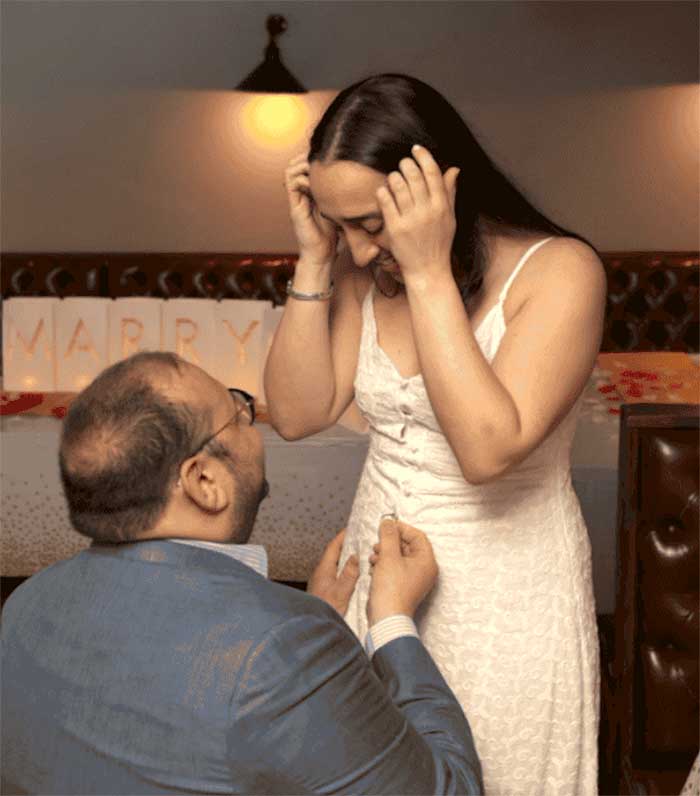
Brett proposing to Liz on June 21, 2025. Photo courtesy of Jonathan Heisler Photography.
Important Considerations?
Last November, Shira Tjong Alvarez, a matchmaker and colleague of Ben Shalom, texted the profile of Yishai, 21, an IDF soldier in an elite unit, to Sara Esther. She saw that he was 6-foot-3, and replied, “I’m 4-foot-11. This is not going to work.”
Ben Shalom had encouraged Sara Esther to narrow down a list of the top 10 attributes that were essential for her in a partner. From Yishai’s profile and talking with older brothers of friends who knew him, he seemed to fit the criteria she was looking for. He was even from a location back in the States that she had envisioned.
Sara Esther noted, “I was saying for a while, I just want a Southern boy who serves in the army … it ended up he’s from North Carolina.” Coincidentally, Yishai had also made aliyah 10 years ago, a few weeks before her.
On Dec. 5, the two had their first date. They bought hot cocoa and coffee at a bakery in Modi’in, and then walked for hours around a nearby picturesque park that had a stream running beneath a bridge. “We walked over that, like a little fairy tale,” she recalled.
She said it was easy to focus on every detail from their conversation. She relayed how “he thinks before he speaks. … I felt like I was listening to his thoughts, and it made me realize how conscious he is of his words and what he says, which is something I really admire.” She learned that Yishai had completed a commander’s course two days before Oct. 7. His entire service as an active soldier has been during the war.
After their second date two weeks later, Sara Esther was on the phone with Yisaha while working at the hospital and thought: “This person’s going to be my husband.”
A couple of days later, she received a distraught phone call from Yishai, telling her that a close friend of his had been killed in battle. Sara Esther relied on Ben Shalom for solace and advice to help her navigate this uncharted territory. “We were still fresh in a relationship, so I didn’t know exactly how he needed to be consoled or how I needed to show up,” Sara recalled.
She met Yishai’s parents at the funeral. “We were like, ‘It’s nice to meet you, but not in this situation,’” she said.
Sara Esther drove Yishai back to his base three hours away, and the subject of the future came up because Yishai’s friend was a newlywed. To lighten the mood, they joked and couldn’t stop talking. “I knew at that point I loved him,” she said. “The whole time we’re driving there, we’re like little kids talking about a wedding and life and the future.” When they got to Yishai’s base, they confessed their love for each other.
Shortly afterwards, Yishai was stationed in Jenin, and suddenly, Sara Esther received a text from him informing her that the soldiers’ phones were being taken away so there would be no distractions. After speaking with Yishai every day for two months, she felt like the rug had been pulled out from under her.
When Sara Esther received a phone call from Yishai’s sister, asking her if she was in a good place, she panicked. She was informed that Yishai was being treated at Rambam Hospital because a bullet had ricocheted into his shoulder. When she got to the hospital, she learned that younger soldiers Yishai trained had also been shot, and that he had valiantly continued to fight even though he was injured. After the bullet was removed, he fought in Gaza for a month before returning to Jenin.
Ben Shalom suggested that Sara Esther figure out if Yishai is the type of person who wants to talk about his physical and emotional pain, or if he prefers to keep things to himself. She emphasized the importance of finding out what it is that Yishai needs.
Yishai expressed how grateful he is that she showed up for him during this time, especially since he wasn’t expecting it. “She was definitely there for me during the darkest time during my army service,” he stated. “I wanted to have that whole ‘hero that woman shows up to take care of.’ It was amazing that the storybook ending actually happened.”
The couple is presently focused on enjoying each other’s company and planning trips together. Sara excitedly described how they recently got engaged on July 3.
‘I knew this could be it’
Choices
Across the world in New York City, Liz, 36, a Food Network video producer, was trying on her wedding dress when JNS called for an interview. She echoed Sara Esther’s sentiments about how the matchmaker who coached her, Kami Verne, who works with Ben Shalom, helped her to make better choices in a partner by understanding what qualities were important to her.
“I had never really thought to or known how to operate from a place that was values first,” Liz said.
By the time she met Brett, 34, a corporate attorney from Philadelphia, he had also been doing self-discovery work with his own matchmaker, Michal Naisteter, to prepare himself to meet the right person, like practicing gratefulness and keeping a positive outlook.
After attending a large singles gathering at a Philadelphia bar that Brett said was “really not my scene,” his matchmaker and Liz’s matchmaker called him, urging him to go to a more intimate cocktail party in Manhattan organized by Liz. They both thought he would like Liz. “Finally, I felt so guilty that I was like, ‘Fine, I’ll go,’” he said.
Brett described meeting Liz as a very quick click. I knew this could be it.” On their first date a week later, Liz said that “within a couple of minutes, I was like, this is so easy. I feel like I know him. I feel like he’s my best friend.” Liz was struck by how familiar Brett felt; he even said a Yiddish expression she knew from her grandmother. “It almost feels like my grandparents are giving me a signal,” she said.
The couple’s matchmakers still check in, but were mostly involved in preparatory work before their relationship took off.
On June 21, Brett kneeled down to propose to Liz in the exact spot where they had their first conversation at the Upper East Side cocktail bar a little more than a year ago.
Regarding finding a romantic partner post Oct. 7, Brett stated: “When things are tough, it’s good to have someone who gets you, who understands the world in a lot of the same ways you do.”
Liz said that even though she and Brett come from very different backgrounds—she grew up in New York City, and he is from Allentown, Penn.—they share similar religious values. They are not observant, but both feel a strong emotional tie to their Jewish heritage.
Liz noted that “it’s hard to find somebody who has exactly the same relationship with their Judaism.”
Ben Shalom, who has a new book out, Matchmaker, Matchmaker Find Me a Love That Lasts, thinks that this is one of the challenges to finding love in 2025. She said there are singles who are not sure how they identify with being Jewish.
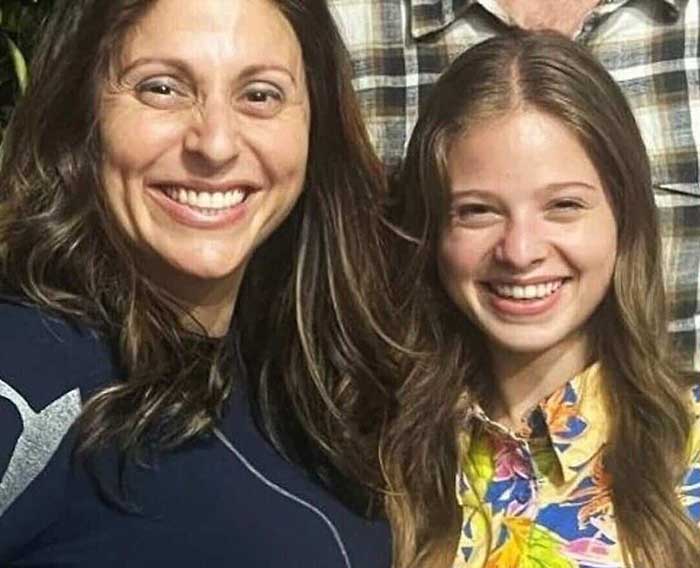
Aleeza Ben-Shalom and Sara Esther Guigui in 2025. Photo courtesy.
Pressures On Singles
“There are Oct. 8 Jews who just woke up to what’s happening, and they’re reconnecting with their Judaism,” she said. “They’re trying to find a partner, and they’re not exactly sure who they are yet.” She described how some of these people are “on pause” because “the first person they’re going to find is themselves.”
Singles have confided in Ben Shalom that they feel guilty dating when hostages remain in captivity, and so many Jewish people are suffering. Others are afraid to attend Jewish events, leaving them isolated.
There is also tremendous pressure on young Jewish singles to meet someone right away and start a family, but Ben Shalom believes that there is not enough community support to foster this.
She noted that while the Jewish community is focused on fighting anti-Semitism, “we’re not putting enough effort into building the future … singles are our future, and building couples and relationships creates a greater community.”