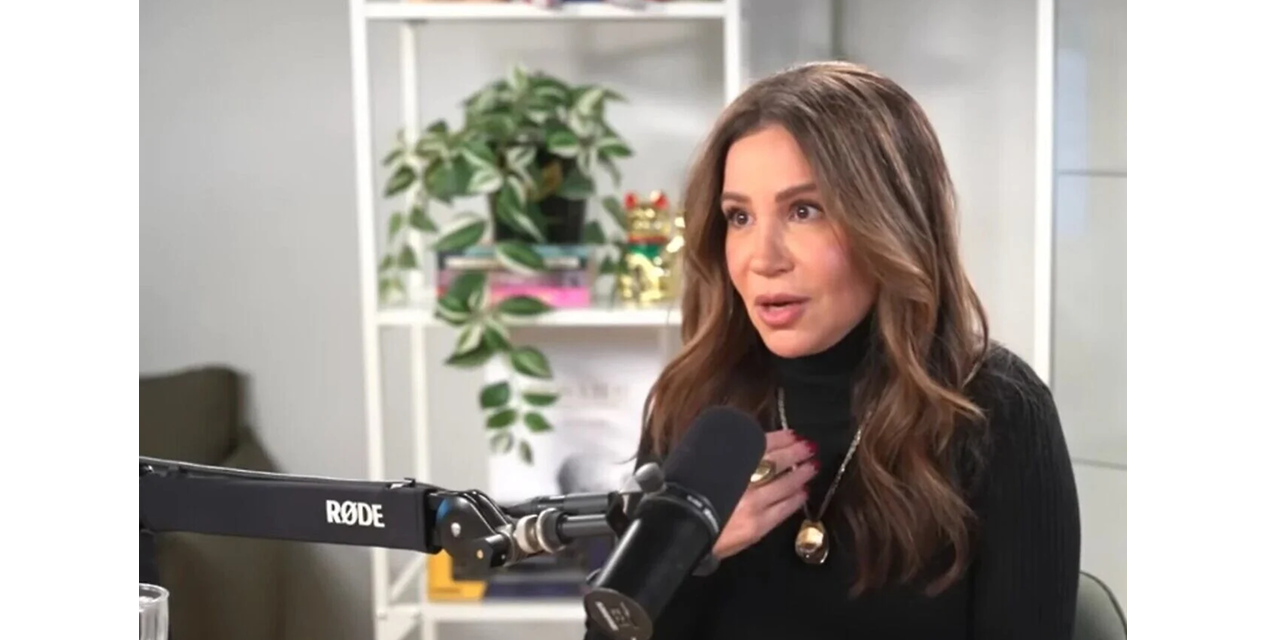
Israeli comedienne Yael Poliakov on her podcast with co-host Assi Azar, Feb. 4, 2026. Photo courtesy of YouTube/Screenshot.
By RUTHIE BLUM
JNS
Contrary to what outsiders tend to assume, Israelis don’t spend all day, every day, obsessing over politics and diplomacy. Nor are all our internal skirmishes neatly sorted along ideological fault lines. Sometimes, the uproar consuming the public square cuts across age groups, ethnic backgrounds and party loyalties. A recent example—one that managed to ignite tempers from every direction—came courtesy of the Feb. 4 episode of the “Assi and Yael” podcast.
Provocative Banter
For those unfamiliar with the pair: Yael Poliakov is a comedienne and actress from one of Israel’s most recognizable entertainment families, known for her blunt, often abrasive humor. Her co-host, Assi Azar—a television personality and openly gay media fixture whose identity forms part of his public persona—is equally well known. In their show, they trade banter meant to be provocative and irreverent.
Body-Shaming
This time, however, they went too far. Or, at least, Poliakov did, without pushback from Azar.
“Lately, I’ve been looking at Instagram, and wherever I swipe, all the [influencers] are getting dressed up in 30 different outfits,” she says, imitating their gestures. “Now, they start out naked. Yes, all of them. Bra, underwear. Doesn’t matter if you’re thin or fat—you start out naked.”
So far, so good. It sounded as though she was about to critique the phenomenon. But then, she took the chat in an unexpected direction, aiming her disgust particularly at the heavy women and girls who engage in it.
“What’s happened with the cows is very interesting,” she said. “The cows use their own fat to get feedback in the form of love and sympathy. Like, ‘Look what a strong woman I am. I don’t care that I have a belly and a tire.’”


Azar then asked, “You don’t have a problem with the thin ones?”
Angry Israeli Women
“I didn’t say that,” Poliakov replied. “I have a problem with both, but when a fat one exploits that [social-media] space and shows up all day in underwear and a bra claiming, ‘I’m your teacher for self-love,’ is that authentic? It doesn’t work on me.”
Dripping with sarcasm, she went on, raising her voice in a shrill crescendo, “We’re not allowed to talk about fat women? Heaven forbid! They’re poor, unfortunate fat women. They have a problem. So we won’t talk about them?” Finally, she shouted, spewing vitriol reminiscent of a death threat: “I’ll finish off the fat women!”
Within minutes, the Hebrew web went ballistic—mainly from angry females of all shapes and sizes.
Particularly poignant was a response from a mother whose daughter had died of complications from anorexia. She warned that rhetoric ridiculing body types, especially when amplified by public figures, can trigger vulnerable listeners already battling eating disorders. Words like these, she said, aren’t mere expressions of an opinion; they fuel destructive behavior.
The broader reaction reflected rage about fat-shaming. Nothing new about the topic in Israel or elsewhere in affluent societies; the rest of the world doesn’t have the luxury to calculate calories on their Apple watches or debate the benefits of intermittent fasting.
But, given the advent of Ozempic Mounjaro and Wegovy—the GLP-1s originally for treating diabetes that help combat obesity, while turning svelte celebrities into emaciated shadows of themselves—it seems almost anachronistic to be making fun of corpulence. Certainly, when political correctness dictates “self-acceptance” and “divergence-empathy,” regardless of how performative and phony.
Still, there was one aspect of Poliakov’s rant that would have merited consideration if it hadn’t been so condescendingly cruel: frustration with the spectacle of scantily clad females posting selfies and reels to garner validation in the form of clicks, shares and views. There’s nothing wrong with critiquing that practice as a worrisome phenomenon.
Where’s The Joke?
The trouble is that she was more interested in calling other women “cows,” a slur both repellent and revealing—you know, about what she sees when she looks in the mirror. The projection was oozing from every notch of the tight belt around her slim waist. Perhaps her taking of jabs was as literal as it was figurative.
To add a twist to the outcry that erupted from the podcast duo’s followers, Azar also received an earful. Not only did he let Poliakov denigrate members of her sex without calling her to task, but he cackled like a hyena.
Content creator Odeya Pinto let him have it in an Instagram story, saying: “If someone had sat there and started going off on homosexuals, you’d have slapped him down verbally, not laughed. What’s funny? Where’s the joke? I didn’t get it.”
Addressing the two of them, she hissed, “Hypocrites. Gross. Makes me want to throw up.”
And there you have it: a tale of the true Israeli “body politic,” though one commenter wondered whether Poliakov would also like to “finish off Hamas.”