
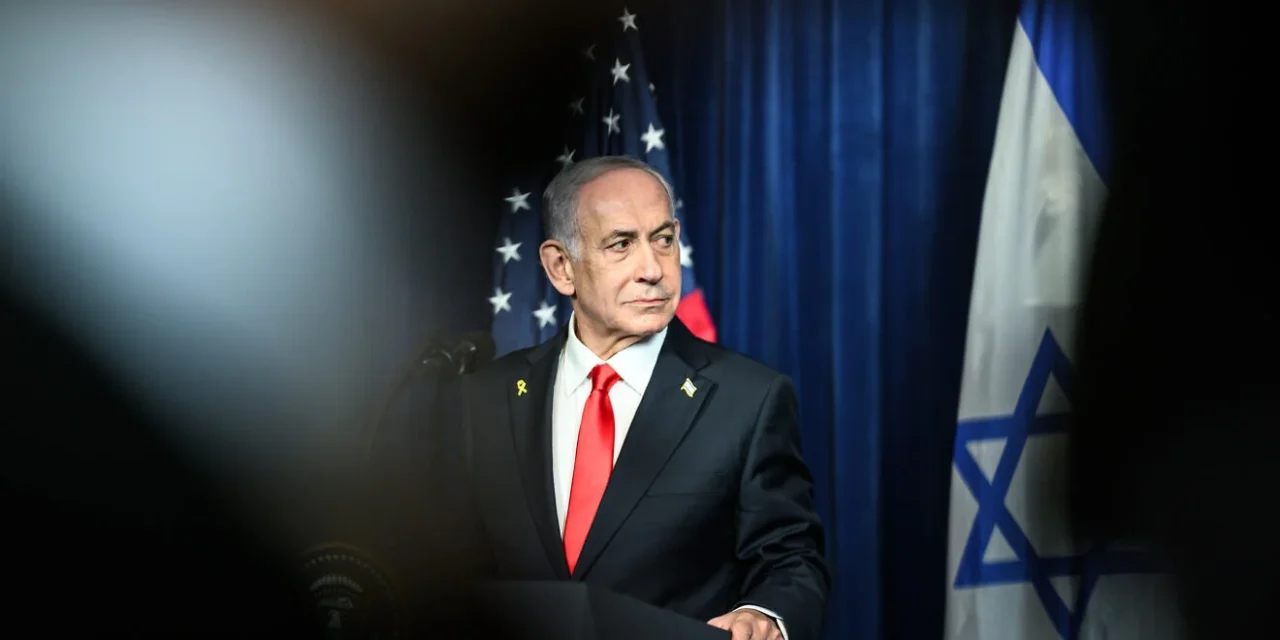
Israeli Prime Minister Benjamin Netanyahu and U.S. President Donald Trump participate in a bilateral press conference at the Mar-a-Lago Club in Palm Beach, Fla., Dec. 29, 2025. Photo courtesy of Daniel Torok/White House.
By MITCHELL BARD
JNS
For decades, Israeli Prime Minister Benjamin Netanyahu has branded himself as one of, if not the ultimate authority on terrorism. His reputation as “Mr. Security” propelled him to become the country’s longest-serving prime minister. That résumé makes one conclusion unavoidable: He bears the ultimate responsibility for the catastrophe of Oct. 7. And from the moment the scale of the failure became clear, he has done everything possible to evade accountability.
Warnings Ignored, Etc
Despite Netanyahu’s relentless efforts to block an independent commission of inquiry, a devastating picture has emerged of warnings ignored and failures dismissed. The latest revelations come from an Israel Hayom investigation based on months of interviews with senior sources who insisted Israel received clear warnings from Egypt in the two weeks before Oct. 7 that Gaza was on the verge of a major explosion. Two Israeli political sources said a senior Egyptian official warned the National Security Council that “something big” was coming. Given standard reporting procedures, sources argue that it is inconceivable that such warnings were not passed on to the prime minister.
Should Have Known?
Whether Netanyahu received a final, actionable warning in the hours before Oct. 7 or was alerted too late to issue meaningful orders misses the larger point. As Israel’s self-proclaimed expert on radical Islamist terrorism, he should have known that Hamas was not deterred. He should have known that the Qatari suitcases of cash he had approved were not funding schools or hospitals, but terror infrastructure. He should have known about the vast tunnel network under Gaza. He should have recognized that the doctrine of “mowing the grass” was failing as Hamas rebuilt, rearmed and refined its plans. He should have understood that his aversion to a costly ground operation signaled weakness, not restraint—and invited attack.
For years before 2023, Israeli civilians were subjected to thousands of rockets from Gaza under Netanyahu’s watch. Oct. 7 was not a lightning strike from a clear sky; it was the culmination of a policy failure years in the making.
Rejected Pre-Emptive Action
Even on the question of the protest movement against judicial reform, Netanyahu cannot evade blame. Senior security officials repeatedly warned him that his judicial overhaul was tearing Israeli society apart and weakening national security. He pressed ahead anyway.
Nor can accountability be confined to Gaza. Netanyahu presided over the years in which Hezbollah amassed a massive rocket arsenal aimed at Israel’s heartland. He allowed that Sword of Damocles to hang overhead, rejected pre-emptive action, and then permitted Hezbollah to devastate northern Israel, forcing tens of thousands from their homes. Under his leadership, the Houthis reached a point where they could fire missiles deep into Israel, sending hundreds of thousands of civilians scrambling for shelter.
On Iran, Netanyahu spent more than a decade warning the world of an existential threat, though he failed to stop it. As with Hezbollah, inaction allowed Iran to build formidable missile and drone capabilities and eventually launch direct attacks on Israel. The relatively limited damage was not the result of Netanyahu’s strategy, but of the extraordinary intervention by the United States, Arab states and other partners. Israel alone would have paid a far higher price.


Bows To Trump
Israel’s enemies have been weakened, but none has been decisively defeated. Netanyahu, for all his rhetoric, settled for something less—primarily to accommodate U.S. President Donald Trump. Trump talks tough about Hamas, threatening “hell to pay,” yet U.S. forces have never struck the group. He blusters about Iran while rejecting the one measure that would end the threat: regime change. Trump has actively blocked Israel from pursuing it.
Thorough Investigation Needed
Evidence has since emerged that Netanyahu immediately understood the disaster would be laid at his feet. Eli Feldstein, a former close aide and spokesperson for the prime minister, said Netanyahu’s first reaction after the attack was to deflect attention from his own responsibility.
That instinct has guided his conduct ever since. Rather than allow an independent investigation, he has proposed an investigatory body stacked with politicians—an arrangement designed to guarantee a predetermined outcome. His allies would blame the Supreme Court, the Israel Defense Forces, the Israel Security Agency (Shin Bet) and the judicial reform protest movement, while any criticism of Netanyahu would be dismissed as partisan sabotage.
President Isaac Herzog spoke for most Israelis when he criticized the idea of a political investigation. “We must conduct a full, thorough and statesmanlike investigation, in accordance with existing law—the Law of Commissions of Inquiry—into the horrific disaster of Oct. 7 and the failure and collapse of judgment that led to it,” he said.
An election is scheduled for October, but Israelis have already voted with their feet. The Times of Israel reported that, for only the fourth time in the past century, Israel experienced negative net migration, with 26,000 more people leaving the country than arriving to live there. Israel has suffered a severe brain drain as people have left because Netanyahu has failed to make the country physically or economically secure. Many loathe him personally and object to his policies.
Political Survival?
Since Netanyahu seems likely to prevent an independent investigation, Israelis will have to pass judgment at the ballot box without all the facts. Despite his record of failure in dealing with Hamas, Hezbollah, the Houthis and Iran, no one should count him out. His Likud Party has never won a majority of the vote, but it is still better positioned to form a governing coalition than his rivals.
But political survival is not exoneration. The man who built his career on security cannot escape responsibility for the gravest security failure in Israel’s history.