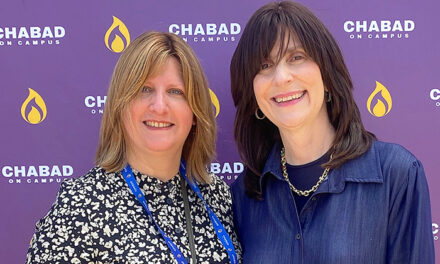

Ronit Elimelech (in orange jacket), seen here at a United Hatzalah event in June 2025, was killed with her mother, Sara, and seven other people in an Iranian missile attack on Beit Shemesh on March 1, 2026. Photo courtesy of United Hatzalah.
By SHARON ALTSHUL
JNS
When emergency sirens sound across Israel, thousands of volunteer medics from United Hatzalah grab their orange medical kits and race toward the scene, often arriving within minutes to provide lifesaving care. Increasingly, many of those responders are women. The growing number of female volunteers within the country’s largest volunteer emergency medical network reflects a quiet but significant shift in Israel’s lifesaving infrastructure.
Racing to Help
That commitment came into sharp focus following the death of volunteer Emergency Medical Technician (EMT) Ronit Elimelech, a 45-year-old mother of three from Beit Shemesh who joined United Hatzalah to help members of her community.
On March 1, the second day of “Operation Roaring Lion,” Israel awoke to the piercing sound of sirens and rockets streaking across the skies. United Hatzalah volunteers were already on heightened alert across the country, ready to respond to any escalation.
By early afternoon, a heavy barrage struck the Beit Shemesh area. Initial reports spoke of widespread destruction and casualties following a direct missile impact. In those first chaotic moments, responders focused on the urgent task before them.
Only later did they learn that the tragedy had struck within their own ranks.
Elimelech was killed alongside her mother, Sara, in the missile strike that hit their neighborhood. Seven other people were killed in Beit Shemesh in the most lethal Iranian attack on Israel since the war began on Feb. 28.


For several hours after the attack, she was listed as missing as rescue teams searched through the wreckage before confirming that the two women had been killed. Elimelech’s children were also injured and hospitalized.
For years, Elimelech had been a steady and reassuring presence in her community. Two years ago, she completed her EMT certification and began responding to emergencies in Beit Shemesh and surrounding neighborhoods.
Residents knew that when they called for help, Ronit might be among the first to arrive, medical kit in hand, bringing both skill and calm to moments of crisis.
Her dedication extended beyond emergency response. Elimelech was also active in United Hatzalah’s Ten Kavod initiative, assisting elderly residents in the community with warmth, patience and dignity.
“Ronit represented everything noble about volunteerism and emergency medicine,” said Eli Beer, founder and president of United Hatzalah. “She combined professionalism with profound compassion. Even in her final moments, as she hurried with her family toward shelter, her medical kit and vest were beside her.”
“There is a particular anguish when a first responder—someone who dedicates their life to protecting others—becomes a victim of the very violence they train to confront,” Beer added.
Across Israel, more than 8,000 United Hatzalah volunteers continue to operate under the threat of missile fire, responding to medical emergencies, trauma incidents and rocket impacts while facing the same dangers as the communities they serve. Over the past two decades, women have become an increasingly vital part of that network. The organization now counts more than 2,000 female volunteers serving as EMTs, paramedics, physicians, midwives and psychotrauma responders.
Female participation began increasing significantly in the mid-2000s and has continued to grow steadily. In recent EMT training courses, women have accounted for roughly 40% of new trainees.
Unique Role For Women
A major milestone was the creation of the Adele and Joel Sandberg Women’s Unit, designed to recruit, train and support female volunteers. The program now includes more than 1,700 women from diverse backgrounds, including Jewish, Muslim, Christian and Druze responders.
Female EMTs often play an especially important role in sensitive situations such as childbirth emergencies or calls involving women in more traditional communities, where patients may feel more comfortable receiving care from female responders. Many also serve as psychotrauma specialists, providing emotional support to victims following attacks, accidents and other crises.
Women are also increasingly assuming leadership roles within regional volunteer chapters.
For colleagues who served alongside Elimelech, however, statistics tell only part of the story.
“Ronit joined because she simply wanted to help people,” said fellow volunteer Naomi Tivon Galeano. “When the siren went off, she was the kind of person who would grab her kit and run. She didn’t do it for recognition or publicity. She just wanted to help.”
“Every call, every shift, every project, she gave everything she had. That was Ronit. That’s the kind of dedication she showed every single day,” Galeano told JNS.
After Elimelech’s funeral, Galeano and another female volunteer dedicated their night emergency shift in her memory.
The dispatch radios in Beit Shemesh normally remain quiet overnight, but that night they were active almost continuously as sirens sounded and emergency calls came in.
The two volunteers were among the first to arrive at several incidents involving women in distress, sometimes reaching patients nearly 10 minutes before ambulances arrived.
For those who knew her, the orange EMT vest Elimelech wore represents something larger than one volunteer. It symbolizes the quiet commitment of thousands of women across Israel who stand ready to respond, often within seconds, whenever someone needs help.