
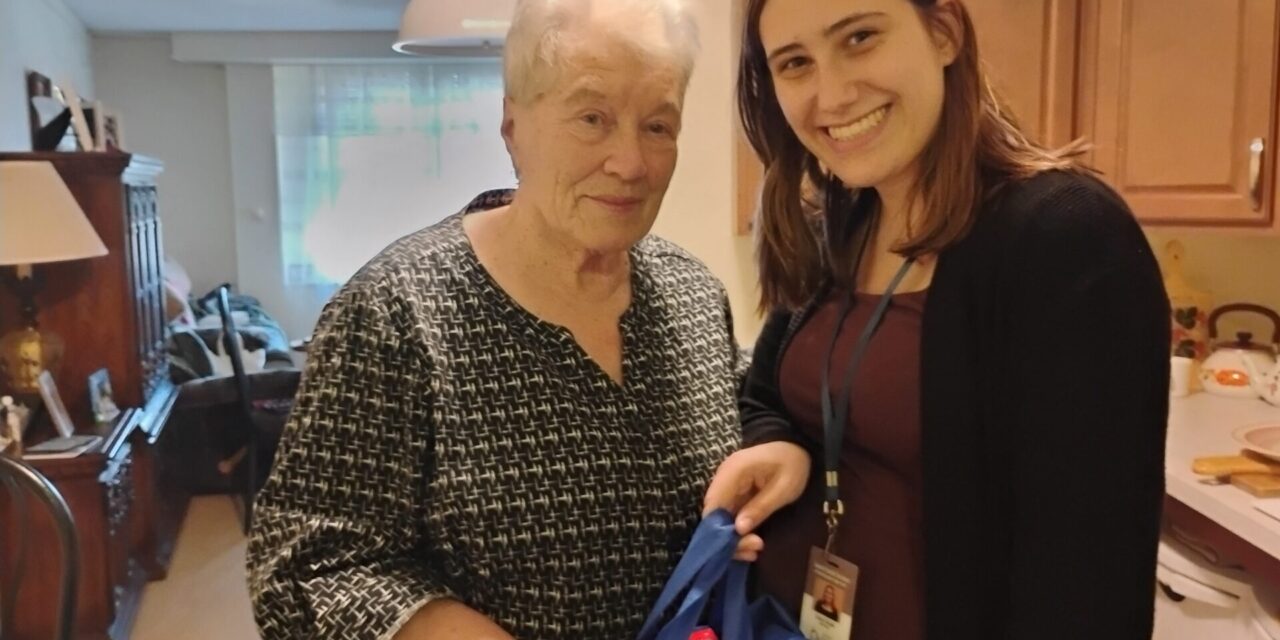
JFS client Alla with Emma Snizek, JFS Master of Social Work intern from Sienna University receives donated groceries when SNAP benefits were suspended.
On the Edge:
Confronting the Hidden Crisis of Jewish Poverty in the Capital Region
By Jane Ginsburg, President & CEO, Jewish Family Services of Northeastern New York
The Capital Region, home to state government, hospitals, and higher education, has long been known for a stable economy. Still, there is a painful, growing reality: a significant and diverse portion of our neighbors, Jewish and non-Jewish, struggle with financial hardship and economic vulnerability. This is evidenced daily by the families and seniors who turn to Jewish Family Services of Northeastern New York (JFS) for assistance.


The National Picture
A recent landmark study, “On the Edge: Voices of Economic Vulnerability in U.S. Jewish Communities,” conducted by the Tulane University Grant Center in partnership with The Network for Jewish Human Services, confirms what we see locally: 29% of Jews are facing economic vulnerability. In other words, nearly one of every three Jews are just making ends meet.
Strikingly, 61% of all respondents reported currently or recently struggling due to situational vulnerability, often triggered by unexpected life events like job loss, a health crisis, or family dissolution. This is not surprising to us at JFS, where the bulk of clients we see are lower-income or living on very fixed incomes – and often socially isolated. More than half of Jewish adults living alone (51%) are age 65 or older. This matters because aging alone is strongly associated with greater financial strain, reduced access to support, and higher risk of unaddressed health and daily living needs.
Not surprisingly, financial hardship is profoundly linked to well-being. The study highlighted that economic adversity often coincides with unaddressed mental health challenges. The Jewish Community Study by UJA-Federation of New York (downstate) highlighted that 49% of adults who say they “cannot make ends meet” also report depression/anxiety. JFS knows this trend all too well, and to address this growing mental health crisis, in addition to myriad other issues – opens the JFS Center for Counseling & Resilience this month.
Localizing the Crisis
At JFS, we see these national trends play out in our area every day, where high inflation, housing costs, and policy changes push vulnerable households to the brink. Nearly two-thirds of the older Jewish adults we serve are living at or below the Federal Poverty Level, struggling to maintain stability on fixed or declining incomes.
Certain groups are disproportionately affected. Russian-speaking Jewish older adult households are among the hardest hit, with 47% of the population poor or near-poor. And within our community’s most vulnerable group, Holocaust Survivors, every client served by JFS Care Management is living below the Federal Poverty Level. JFS is answering this crisis through a concerted effort to address financial burdens for our local survivors in partnership with Jewish Federation, KAVOD SHEF, and Seed the Dream Foundation to provide funding for as many medical and personal needs as possible.
Demand for healthcare navigation and advocacy is also climbing sharply. With medical systems becoming more complex and insurance processes increasingly difficult to understand, older adults are encountering barriers that can quickly escalate into crises. Yet help with benefits applications, billing issues, appeals, and care coordination can both prevent avoidable emergencies AND protect limited household resources for those already living on the financial edge.
How JFS Helps
These trends signal a critical moment for our community. As more Jewish older adults face poverty, isolation, and complicated health challenges, expanding access to coordinated advocacy, support, and compassionate guidance will be essential to helping them age with dignity, stability, and connection.
The Jewish community in the Capital Region has come to rely on JFS to be the essential bridge for those on the edge. Our services provide both short-term interventions and long-term support to stop the spiral of a situational crisis. We respond with both compassion and competency.
For Those Who Are Struggling: You Are Not Alone
If you or a loved one is experiencing vulnerability, or simply struggling to manage, please know that JFS-NENY is here to help you. We are confidential and non-judgmental. We can help you navigate complex systems, secure benefits and essential needs, and offer counseling.
To Our Generous Donors and Future Donors: Be the Bridge to Stability
When you support JFS, you are not just funding a program; you are directly investing in a neighbor’s stability and dignity. Your gift immediately translates into concrete help to meet escalating demand and keep the promise that no one in our community is left alone and on the brink.
To reach JFS, please visit jfsneny.org, or contact us at 518.482.8856 ext. 0 or info@jfsneny.org.