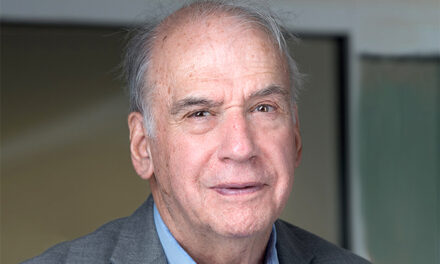

Pennsylvania Gov. Josh Shapiro holds a roundtable discussion at the Wyoming County Emergency Management Agency in Tunkhannock, Penn., Jan. 15, 2026. Photo courtesy of the Office of the Pennsylvania Governor.
By JONATHAN D. SALANT
Pennsylvania Gov. Josh Shapiro says he has become more open about his Jewish faith in the wake of the mass shooting at a synagogue in Pittsburgh, Penn., and the Hamas invasion of Israel and subsequent rise of Jew-hatred worldwide.
“As people have approached me and expressed to me the fear that they have to live openly about who they are in this country, I have felt the responsibility to be more open about my faith, to offer some comfort to them,” Shapiro, a Democrat, told a group of reporters at an event sponsored by The Christian Science Monitor.
He said this was a result of the massacre of 11 Jewish worshippers on Oct. 27, 2018, at the Squirrel Hill synagogue housing three different congregations—Dor Hadash, New Light and Tree of Life—and the Hamas-led terrorist attacks in southern Israel on Oct. 7, 2023.
Offering Comfort
“I’m very proud of my religion and proud of my faith,” said Shapiro, 52, who lives in the Philadelphia-area suburbs and has been mentioned as a potential 2028 Democratic presidential candidate.
“But I think that’s true of people from all different faiths and all different walks of life who may feel targeted in this country right now and they feel scapegoated by this administration,” he said. “I do feel a sense of responsibility, because of who I am, to offer some comfort.”
Shapiro recounted an incident in his new book, Where We Keep the Light, when he met the grandson of someone who used to work for Jimmy Carter at the late president’s funeral.


The man wanted to tell Shapiro that “how I lived my life, how proud I am of my faith and how I practice, and what I believe makes him more comfortable about being open about his faith and being proud of who he is,” Shapiro wrote.
“To hear that it’s impactful to others, particularly to young people who take it in, made me think about it in ways that I had not before,” he added.
The governor told reporters that the encounter has stayed with him. “Conversations like that hung with me in a way that makes me feel that I have this responsibility now to offer comfort to others,” he said.
Shapiro experienced anti-Semitism firsthand when a man set the governor’s mansion in Harrisburg, Penn., afire shortly after Shapiro hosted a Passover seder. No one was injured, but the city joined Washington, D.C., and Boulder, Colo., as the locations of violent attacks against Jews by anti-Israel assailants.
The governor wrote about the arson attack in the first chapter of the book, “A Night Guarded by God,” referring to Torah references about the seder night.
“It was a night God guarded for the purpose of leading the Israelites out of Egypt and one that remains guarded for generations to come,” he wrote. “It’s so guarded that some rabbis have long said you don’t even need to lock your doors,” he added. “Harm did try to find its way in, but this night had, in fact, been guarded.”
Shapiro also wrote that he looked to the victims of the Tree of Life massacre for guidance in living as a Jew during a time of such anti-Semitism.
Religious Practice
“There have been times where I have struggled to figure out what my responsibility is as a person so public about my faith, at a time when it is more tenuous than ever to be Jewish in America,” he wrote. “In these moments, I look to the Tree of Life community as my guidepost for what it means to live our faith out loud, without fear or question.”
Shapiro said at the Monitor event that he has a deeper connection to Judaism today, even as his approach to practicing his religion has changed.
“I grew up, as I write in this book, as someone whose faith was tied to the practice of religion,” he said. “I would go to synagogue regularly. I would pray regularly, but I would oftentimes pray in an institutional setting, in a synagogue. And I followed the rituals and the practices and the way that my parents raised me to follow.”
Things are different today, he said.
“As the years have gone on, in many ways, I have practiced less in a religious setting,” he said. “But I pray more. I do less of the religious steps but find myself having a deeper connection to my faith and leaning on it more.”