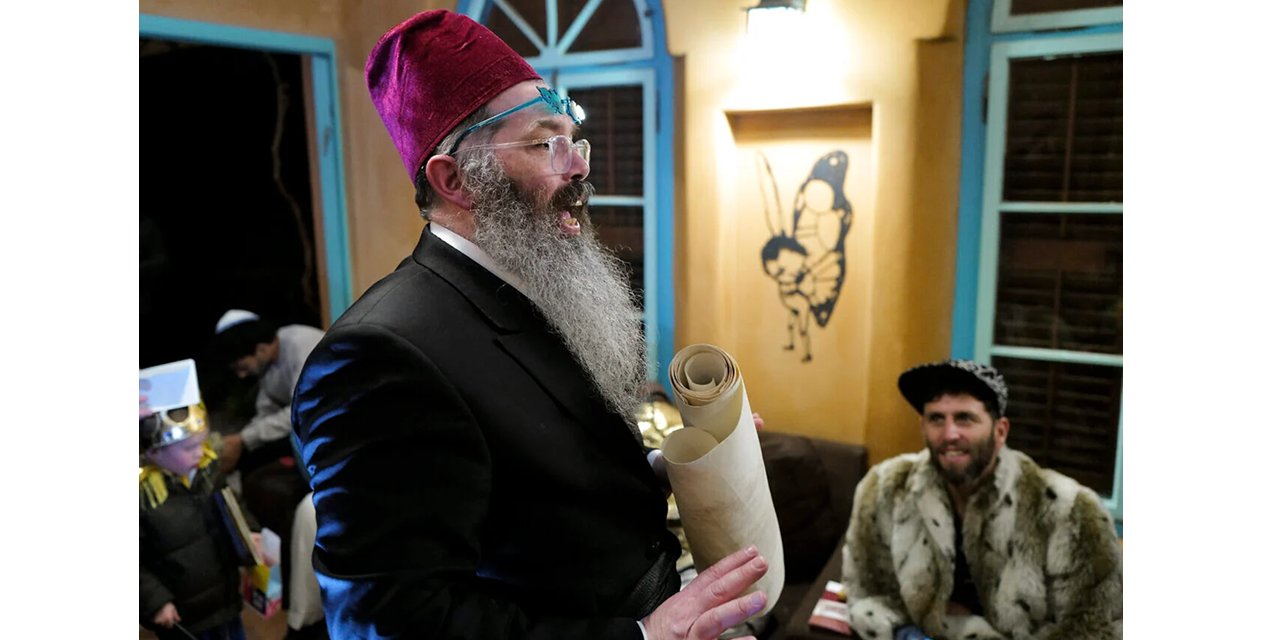
Jews reading the story of Esther (Megillat Esther) on the eve of the Jewish holiday of Purim at a house in Kibbutz Hukok in northern Israel, March 2, 2026. Photo courtesy of Michael Giladi/Flash90.
By STEPHEN M. FLATOW
JNS
I write these words from Jerusalem in a country at war.
Ever since my first child was born, I have been fascinated by Purim.
Unsettling
Of all our holidays, none invites us into the world of our children the way Purim does. We dress our daughters as Esther and our sons as Mordechai. We allow noise in the synagogue. We beam as infants in costume are passed from arm to arm. It is joy, mischief and memory rolled into one.
Yet beneath the laughter lies something unsettling.
The Megillah opens with the familiar words: “And it came to pass in the days of Achashverosh.” Our sages teach that when a story begins that way, trouble is ahead—but it will ultimately turn out well. A genocidal decree is signed. A date is set. The Jews of Persia are marked for annihilation.
And then—through courage, faith and stubborn refusal to bow—the story turns.


We read it every year as though we do not know the ending. We cheer when Haman falls. We celebrate deliverance.
But this year, it feels different.
A Different Outcome?
On Oct. 7, Hamas did not merely threaten genocide; it attempted it. Families were slaughtered in their homes. Babies and the elderly were dragged into captivity. The language of annihilation was not metaphorical. It was operational.
Haman had a decree. Hamas had trucks, guns and missiles.
Behind Hamas stands modern-day Persia—the regime in Tehran that funds, arms and directs the very forces sworn to Israel’s destruction. Hamas has long been supported by the Islamic Republic, as has Hezbollah in Lebanon and other Iranian-backed proxies encircling the tiny Jewish state.
For decades, Iran’s rulers have positioned themselves as heirs to an ideology that speaks openly of wiping Israel off the map. They have built a ring of fire around the Jewish state from Gaza to Lebanon, from Yemen to Syria, investing billions in terror and in missiles aimed deliberately at civilians. What was once theoretical is now kinetic.
Purim reminds us that Jews in exile are vulnerable when power rests entirely in the hands of others. In Shushan, the fate of the Jews hinged on palace politics. Their lives depended on access to a king.
Refusal To Disappear
Today, Israel exists precisely so that Jewish fate is not subject to the whim of foreign rulers.
That is the great post-Megillah revolution of Jewish history: sovereignty.
Yet sovereignty carries its own burden. The Jewish state must fight. Its sons and daughters stand on the front lines. Reservists leave families and businesses behind. Religious and secular soldiers alike shoulder the same rifles and the same risks. They are today’s Mordechais—refusing to bow, refusing to disappear.
What Haman Represented
As a father who lost a daughter to Iranian-sponsored terror in 1995, Purim has always carried a double meaning for me: joy and memory, celebration and warning.
Haman failed. But the impulse he represented did not disappear.
It resurfaced in those who allied with the Nazis. It resurfaced in suicide bombers sent onto buses. It resurfaces today in chants across Western campuses calling not for coexistence but for Israel’s eradication.
The Megillah famously does not mention the name of God. Divine intervention is hidden. Salvation unfolds through human courage, moral clarity and collective resolve. That may be the most relevant message of all.
We cannot assume that history bends toward justice on its own. Esther had to act. Mordechai had to refuse. The Jewish people had to stand together.
The Struggle Seems Timeless
So yes, here in a subdued Jerusalem, we will still dress our children in costumes. We will still drown out Haman’s name. We will still deliver mishloach manot to neighbors and soldiers alike. But we will do so knowing that Purim is not a fairy tale. It is a reminder that Jewish vulnerability is real, and so is Jewish resilience.
In Shushan, the Jews defended themselves. In Jerusalem today, they do the same.
And as the Megillah is unrolled in a nation still at war, the ancient words feel less like distant history and more like living memory.
The story is timeless because the struggle is timeless. But so is the survival.