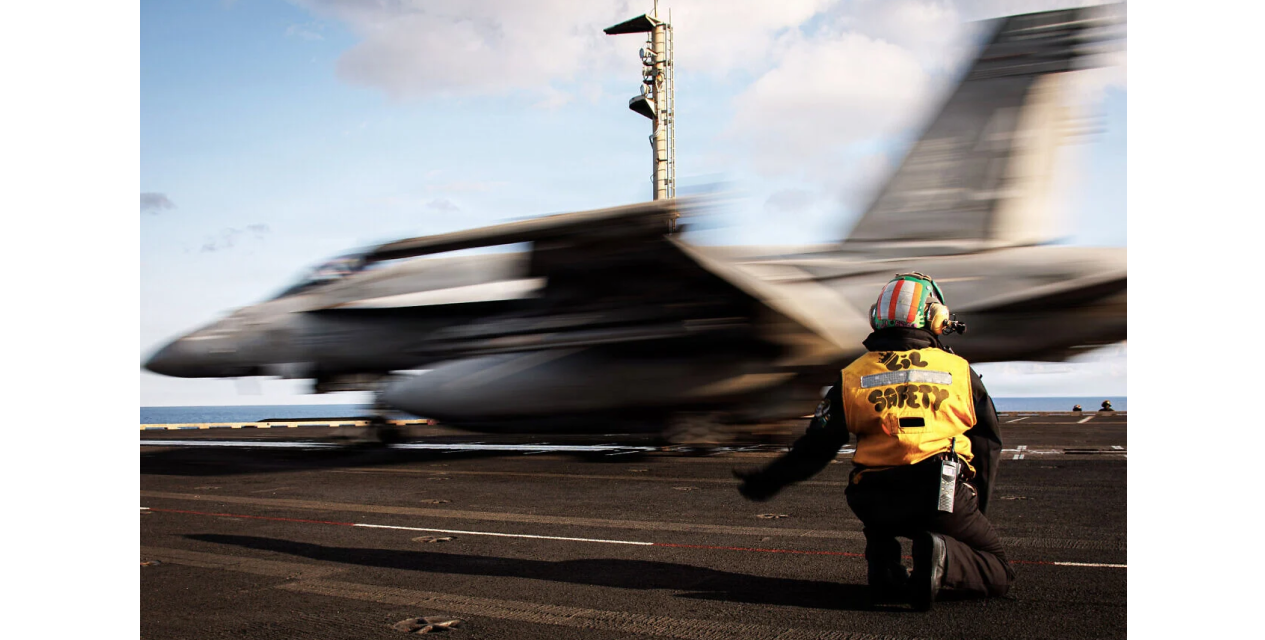
A U.S. sailor signals the launch of an F/A-18E Super Hornet aircraft, attached to Strike Fighter Squadron 37, from the flight deck of the world’s largest aircraft carrier, USS Gerald R. Ford (CVN 78), while operating in support of “Operation Epic Fury” in the Eastern Mediterranean Sea, March 2, 2026. Photo courtesy of the U.S. Navy.
BY MITCHELL BARD
JNS
When U.S. President Donald Trump deployed F-22 Raptor fighter jets to Israel—and followed that decision with joint military action against Iran—most observers saw a tactical military move. It marked something far larger: the collapse of a foreign-policy orthodoxy that had dominated Washington for nearly eight decades.
National Interest
For the first time since Israel’s founding, a U.S. president openly rejected the long-dominant foreign-policy doctrine promoted by Washington’s “Arabists”—the officials in the U.S. State Department, CIA and Pentagon who insisted that close strategic cooperation with Israel would devastate America’s standing in the Arab world.
They were wrong for 78 years. Only now has a president fully ignored them.
The term “Arabist” does not merely describe regional expertise. It refers to a particular class of diplomats and intelligence officials whose long immersion in Arab capitals produced what foreign-policy veterans once called clientitis: the tendency to internalize the worldview of host governments and present it in Washington as the American national interest.
Their assumptions, which were repeated so often that they hardened into catechism, shaped generations of policy: America must placate Arab regimes to secure oil. Support for Israel damages U.S. regional relationships. The Palestinian issue is the root cause of Middle East instability. “Evenhandedness” requires pressuring Israel. Israel must be restrained for its own good. Close ties with Israel provoke anti-American terrorism. And the Israeli lobby distorts policy to the detriment of American interests.
These convictions predated Israel itself. Arabist officials opposed partition, tried to block U.S. recognition of the Jewish state and persuaded President Harry S. Truman to impose an arms embargo that many of them hoped would doom Israel’s survival.


Israel survived. Arabist thinking did, too.
Throughout the Cold War, Arabists argued that Arab regimes were America’s indispensable partners and Israel a strategic liability. President Dwight Eisenhower initially embraced this view, only to discover that Israel proved dependable while many Arab allies proved fickle or hostile.
Reality Refutes Theory
Still, the doctrine endured. It delayed U.S. arms sales to Israel, constrained cooperation during the 1967 war and treated Israel’s military victories as diplomatic embarrassments, rather than strategic assets.
The 1973 oil embargo seemed to vindicate Arabist fears—until reality intervened. Oil producers ultimately needed American markets and security guarantees more than America depended on them.
Over time, the Arabist prediction collapsed entirely. As U.S.-Israel ties deepened, relations with Arab states did not deteriorate. They improved.
Reality refuted the theory. Theory survived anyway.
Constant Concessions From Israel
The implementation of their policy was evident in the first Gulf War. When President George H.W. Bush assembled a coalition to liberate Kuwait, one country was excluded: Israel. Even as Saddam Hussein rained Scud missiles on Israeli cities, Bush insisted that Israel absorb the punishment without responding—sacrificing an ally’s sovereignty to the Arabist fear that the coalition would collapse if Israel fought back.
From Nixon through Obama, every president pursued Middle East peace initiatives grounded in a single assumption: resolving the Israeli-Palestinian conflict would stabilize the region, and Israel was the obstacle to peace. Policy, therefore, focused relentlessly on extracting concessions from Israel.
History rendered its verdict. Regional instability stemmed not from Jerusalem but from revolutionary regimes, sectarian rivalries, Iranian expansionism, jihadism and Palestinian rejectionism.
The Abraham Accords shattered the Arabist worldview. For decades, diplomats insisted Arab states would never normalize relations with Israel before Palestinian statehood. Then the United Arab Emirates, Bahrain and Morocco did precisely that—joining Egypt and Jordan in proving that Arab governments can pursue their own strategic interests without being held hostage to Palestinian maximalism.
Former President Joe Biden brought the Arabists back. Many of the same officials responsible for Obama’s most damaging policies—the campaign to force Israel into one-sided concessions and the nuclear deal that enriched and empowered Tehran—returned to positions of influence. Even after the Hamas massacre of Oct. 7, they attempted to constrain Israel from acting decisively against the terrorists, Hezbollah and their Iranian sponsors.
When Trump returned to the White House for his second term, U.S. Secretary of State Marco Rubio continued the purge of Arabist influence from the State Department. Trump’s posture toward the Arab world was transactional: Unlike his predecessors, he expected something in return for American support.
When planning operations against Iran, the strategic reality became impossible to deny. Only Israel was prepared to stand with America. Gulf States hosting U.S. bases—nations that had received decades of arms sales and security guarantees—refused their use against Tehran. Despite everything Washington had invested in those relationships, they hedged when it mattered most. Iran attacked them anyway.
When Trump deployed advanced U.S. aircraft to Israeli bases—an unprecedented step that Arabists had warned for generations would ignite the region—no explosion occurred. The Arab street did not erupt. Alliances did not collapse. The sky did not fall. The Arabist nightmare scenario, invoked for 78 years to justify keeping Israel at arm’s length, simply did not happen.
Ignoring The Chorus
Meanwhile, Arabists and other critics insist that Trump never explained to the American people why military action against Iran was necessary, ignoring the video address in which he did precisely that.
They claim that Iran does not threaten the United States. This requires remarkable amnesia. Iran has been at war with America since 1979, when revolutionaries stormed sovereign U.S. territory—the embassy in Tehran—and held more than 50 Americans hostage for 444 days. Iranian-backed Hezbollah has killed more Americans than any terrorist organization except Al-Qaeda on Sept. 11, 2001. Iranian-backed Hamas murdered and kidnapped Americans on Oct. 7, 2023.
Iranian operatives have plotted assassinations of dissidents and American officials on U.S. soil. “Death to America!” is not a fringe slogan in Tehran; it is state liturgy.
Diplomacy Failed
Opponents argue that if Trump’s claim of destroying Iran’s nuclear facilities was accurate, then the threat would have been neutralized. This ignores the fact that even after the airstrikes, Iran retained enough enriched uranium to build a dozen bombs. The threat was degraded, not eliminated.
Others object that Iran did not yet possess a nuclear weapon. That is precisely the point. Waiting until Tehran crossed the threshold would have repeated the North Korea catastrophe—replacing the possibility of prevention with the permanence of vulnerability.
Iranian missiles cannot yet reach the American homeland, critics note. Perhaps not today. But their range was steadily increasing, they were being engineered to carry nuclear warheads, and as recent events demonstrated, they could already strike American personnel and assets across the region.
Diplomacy had already failed. Iran rejected limits on enrichment, missile development and proxy warfare. The Obama-era 2015 nuclear deal did not resolve the confrontation; it only postponed it while empowering the regime that created it.
No lasting peace in the Middle East was possible as long as the Iranian regime remained in power. Its ambition was not merely regional dominance but the global spread of radical Islam. The Iranian people needed help. As Trump said, past presidents had been unwilling to provide it, and each time, the hopes of ordinary Iranians were crushed. The United States cannot impose a government on Iran’s people, and it cannot hunt down every functionary of the regime. Ultimately, Iranians will decide their own future. But the path is being cleared.
Arabism has not disappeared. It has migrated. Its former practitioners now populate think tanks, television studios and editorial pages, repeating arguments disproved by decades of events. Journalists continue to rely on them because they reliably supply quotes reinforcing familiar anti-Israel narratives.
The script never changes: Israel is the obstacle, distance from Israel is wisdom, and concessions will produce peace.
Trump ignored that chorus. And events vindicated his judgment.
The deeper significance of the Iran operation is not military but doctrinal. American strategy is finally aligning with geopolitical reality: Israel is the region’s most dependable ally, not its greatest liability.
The collapse of Arabist orthodoxy opens possibilities that were unthinkable a generation ago. The United States may increasingly treat Israel as a forward strategic partner rather than basing critical assets in countries that hedge against American interests at the first sign of risk.
Stronger Together
Whatever their reservations about Trump’s methods, Democrats would be wise to recognize the lesson. The old framework failed—repeatedly, predictably, and at great cost. Returning to it would mean reviving policies that produced neither peace nor stability.
For decades, Washington feared that standing too closely with Israel would isolate America in the Middle East. The opposite has proven true. Every step toward Israel strengthened, rather than weakened, America’s regional position.
The Arabist era is ending—not because ideology changed, but because reality finally became impossible to ignore.