
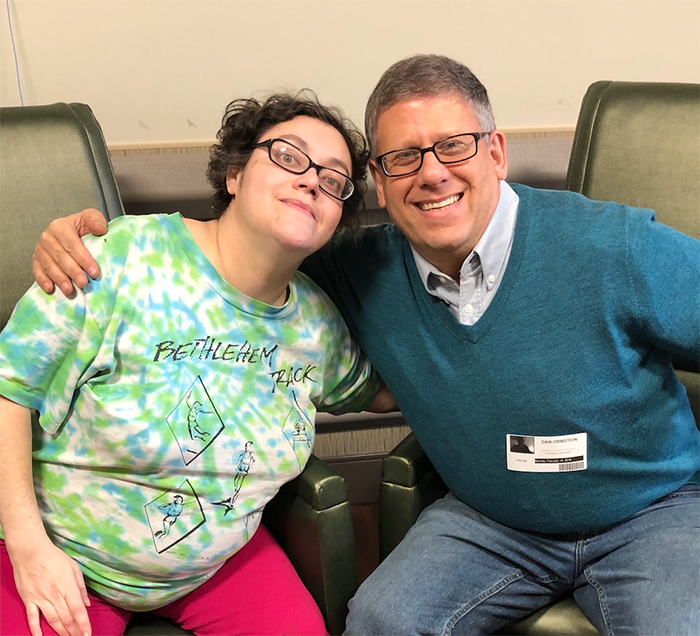
With Rabbi Dan Ornstein
By RICKI LEWIS
Huntington’s Disease (HD) is not one of the so-called Jewish genetic diseases, but it ravaged three generations of a Jewish family living in the Capital District. Alan Pfeffer of Glenmont is an attorney and an advocate for HD patients: he champions nursing home care and leads efforts to educate legislators and convince them to improve care.
His book Charise, A Woman With Huntington’s Disease Who Changed the World: Her Poetry and Memoir, pays tribute to his extraordinary daughter, who died at age 43 in 2024. She had lived with HD since diagnosis at age 29. Her mother had been diagnosed when Charise was just 8. Her mother’s father had it too.
A Quick Science Lesson
HD is passed from parent to child with a risk of 50 percent. I’m a geneticist and love dwelling on the science, but Pfeffer wisely and accurately summarizes it in a preface, quickly getting to the human story. So I’ll do that too.


HD is one of more than 20 conditions caused by a triplet of specific DNA subunits (cytosine-adenosine-guanine, or CAG) that expands from generation to generation. Most people have 20 or so copies; in HD the number exceeds 40. Charise’s was 48. Genes encode specific proteins, and the too-long gene specifies a too-long protein, huntingtin, which gums up the movement center of the brain.
Genetic testing can detect the condition at any age, even well before the symptoms of uncontrollable movements begin. Testing isn’t typically advised until age 18.
A Gifted Writer
Charise was born in Niskayuna in 1980, and graduated from the Hebrew Academy of the Capital District, Bethlehem High School, and the University of Maryland.
She had a wonderful, if challenging, two years as a Peace Corps volunteer in Turkmenistan, where she taught English and self-esteem to children. She also taught children in Thailand and foster children in Israel, and traveled the world.
Charise was a gifted writer, which inspired her father to publish some of her work. Positivity and humor spring from her clever words.
As a senior in high school, “Fiddler on the Roof” inspired “If I Were a Couch Tater.”
If I were a couch tater,
Yai de dai da dai da daidle ya daidde dadde de
All day long I’ll piddly away the time
If I were a lazy girl.
In sharp contrast is “In the Dry Desert,” published in the 1997 Bethlehem High School literary magazine. An excerpt:
The ancient voices whisper.
Masada shall not fall again.
Hushed echoes of the prayers
Of those who sacrificed
Reverberate off the sharp, fitted edges.
The cracks the heated stone,
Like parched lips,
Speak.
Demand not to be forgotten.
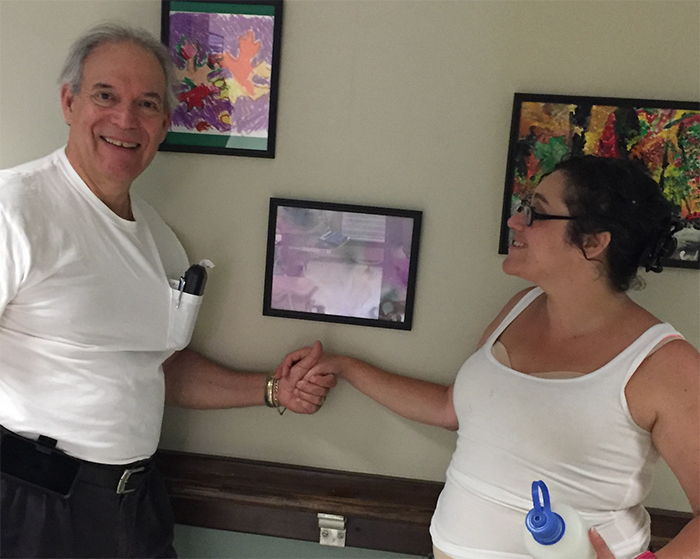
With Alan and her art
An Ode to Odd, Uncontrollable Movements
The disease was once called Huntington’s chorea, named for the characteristic uncontrollable, repetitive, dance-like movements that include fidgeting, squirming, and jerking. Charise describes the mortification of misunderstanding chorea in “At a Restaurant in Lee,” written in 2014.
People stare at me
I want to glare back at them
But I’m too busy
Dropping my napkin
Picking it up
Dropping my napkin
And picking it up — again
And picking it up – again
Attempting to grasp this foreign fork and knife
As pithy pieces of lettuce
mockingly dancing and prancing,
Mexican jumping beans
they leap into the air and onto the counter
One after the other
One after the other
Could swear I just picked this one up
Damned leaves of lettuce all look alike,
without warning a flash flooding of sticky white fluid
splashes
into the bowl
everywhere
nearly falling off my chair
Drunk, they no doubt think
And I want to yell;
What are you looking at?
Lush
She’s had one too many
they no doubt think
I want to demand
Didn’t your momma ever tell you
It’s rude to stare.
Years later, Charise returned to the theme of presumed drunkenness, in a discussion with her rabbi. She related being in the Bahamas, loading her luggage onto a bus, weaving back and forth.
“Some guy looked at me, and started joking, ‘How many Bahama Mamas have you had?’”
“Another guy chimed in, ‘She’s three sheets to the wind!’”
She wished she’d said:
““HD affects your balance.
HD affects your cognitive and motor skills.
HD affects your judgment.
You’re treating me in a way that’s really disrespectful and embarrassing.”
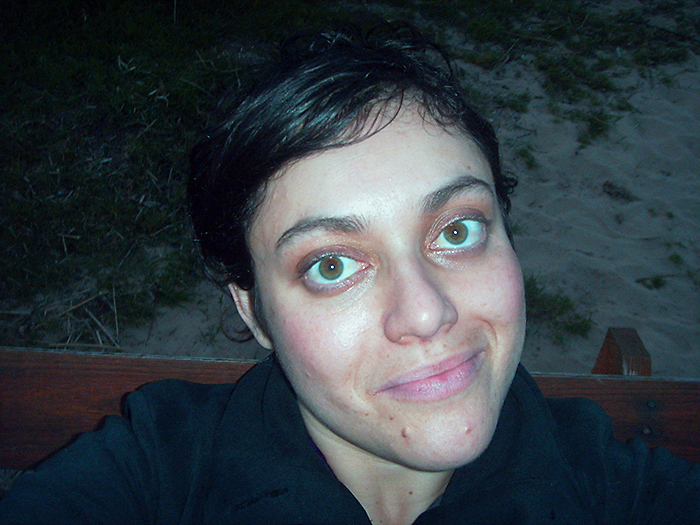
Buenos Aires, 2009
Eloquent Capturing Her Plight
Charise was achingly self-aware. Her words bring the reader into her predicament.
At 32 I find myself trapped
There is no cage and yet every day
the bars grow stronger and stronger around me …
My swiss-cheese-holed memories
Through feelings and brains
As the pen slips through my grasp (yet again) wicked pen!
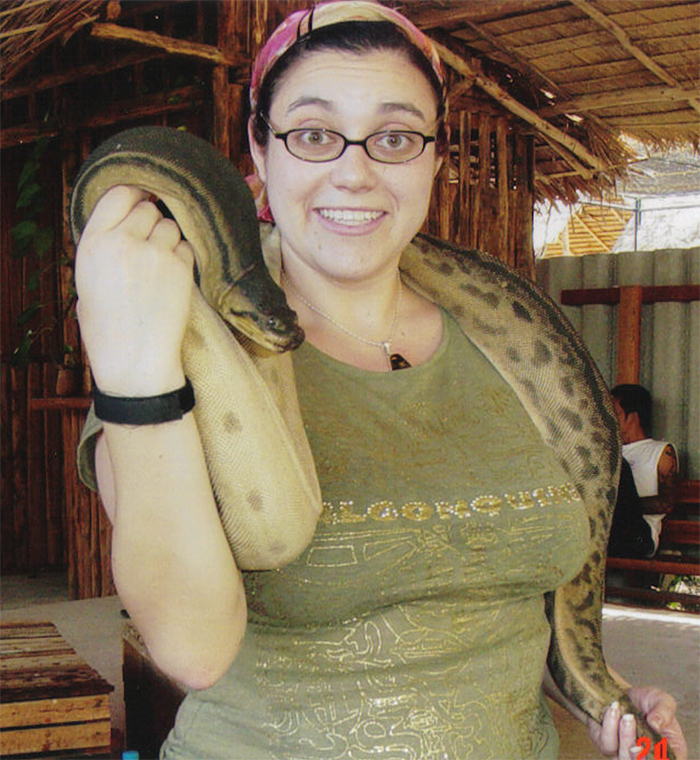
With cobra, Thailand
If her brain is a Swiss cheese, then her whole body is a tree, in the poem Deadining.
Delicately separating the vivid bright green
Thriving living leaves
From the dark decrepit ones
The ones that without a whimper
Without a whisper simply crumble into dust
A tougher task than one might imagine
Turning over the robust stems to reveal
Dark decaying summer
Hidden underneath
Foraging past glorious lush
Vibrant stems
Deceivingly healthy
On the outside
To reveal the mottled yellow-brown parts
Dying on the inside
Must be careful,
Nimble decisive in this endeavor
Attempting to save the precious purple and pink bulbs
As I must to myself am I more jealous of the plants who will live healthy lives
Or those who get to die quickly quietly simply and with dignity.
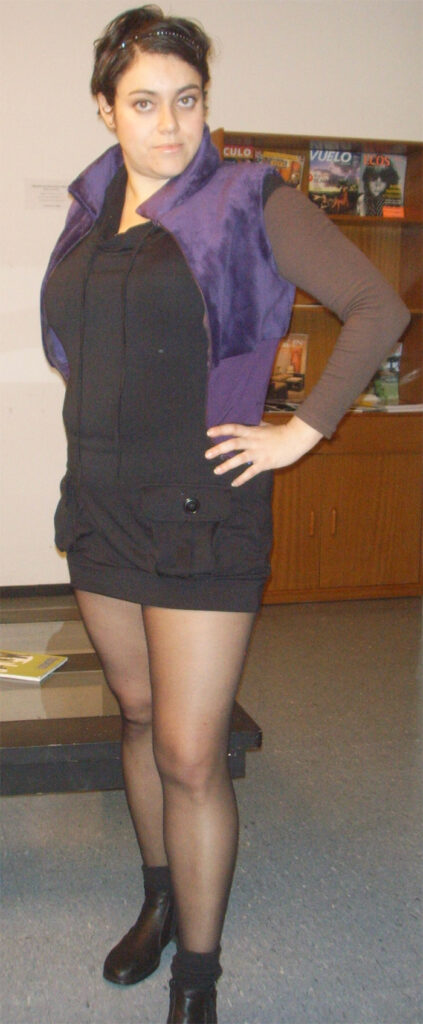
Buenos Aires, 2009
Public Outreach
Father and daughter chose not to hide HD, but to inform others, through public education and advocacy. “My greatest accomplishment was getting the State of New York to agree to pay a higher reimbursement fee under Medicaid for specialized nursing homes treating HD residents,” Pfeffer writes.
For many years he and a social worker trained sheriff’s offices, corrections officers, 911 offices, and police to recognize when a suspect might have HD. He was instrumental in supporting the Medical Aid in Dying (MAID) Act, which the New York State legislature passed in 2025. Charise’s advanced directives were crystal clear: no feeding tube, no antibiotics, no ventilators, and a DNR on file at the nursing home where she spent her final years.
The last entry in the book, “Hell Piece,” stays with me, in its simplicity and profundity.
Charise is a junior in high school, imagining the horror that is her mother’s life, but written in the first person, perhaps envisioning her own future.
In “Hell Piece,” a young woman sits propped up in her nursing home recliner in her room, watching people walk back and forth in the hallway under the constant fluorescent lights. An annoying man hawks a stainless-steel vegetable knife on the blaring TV, on and on. And then an inquisitive fly begins to torture her, as her body betrays her, rolling her head back and forth in the eerie repetitive motions of HD.
After lamenting the gross hairy legs of the buzzing fly, Charise imagines it landing on her trapped mother.
“I wish I had more control. The fly has landed on my thigh! I can see its horrid black front legs rub together in anticipating of biting my pale unsuspecting innocent skin. If only I could move my hand, I would curl my fingers into a fist and come down hard on that thing! Squish! Ugh! That would teach him a lesson, all right. Thankfully, the wretched beast takes off in search of a more ambulatory victim.”
Charise passed away on May 5, 2024, suddenly and peacefully, her heart stopping, before she became completely rigid and unable to move. Her father was thankful for that.
Huntington’s and me
I am a science writer and geneticist, with a curious connection to HD. My first ever newspaper article was about the disease. A clipping somehow found its way from Bloomington, Indiana, where I was pursuing my PhD, to Marjorie Guthrie, Woody’s wife. She wrote me a letter that I shoved into a back pocket, and when washing my jeans, I found it. She invited me to meet her the next time I was in NYC visiting my family, and I did – she and Arlo encouraged me to go into science writing.
In my first faculty position at Miami University in 1980, a student, Margaret Wallace, worked in my lab, and then went on to do her PhD research in Dr. Michael Conneally’s lab at the IU School of Medicine in Indianapolis. In 1983, very late one Tuesday night, she called me, excited. In going over data, she realized that her team had discovered the Huntington’s marker in blood samples that researcher Nancy Wexler and her team had collected from a huge family with HD in Venezuela. Having the marker made possible presymptomatic diagnosis and paved the way for discovery of the gene a decade later.
Then in 2014, I began volunteering for Community Hospice in Schenectady. My first patient was a man with HD who was the same young age as Charise when she passed away. I shared music with him on my iPod, nearly every day for his remaining months, he communicating with raised eyebrows to my yes-or-no questions. Shortly before he passed, trapped in his body, the movements ceased, I called Dr. Conneally to ask why my patient couldn’t close his eyes. “Ricki, he can no longer blink.”
A few years later, I worked for the Cure Huntington’s Disease Initiative Foundation, sitting in on private research workshops and writing up technical reports on the brainstorming discussions.
I was excited to review Alan Pfeffer’s book. It is available at Amazon.





My husband was on PD-5 formula for Huntington’s disease from Limitless Health Centre for 6 months. He sleeps soundly for 8 hours, works out frequently. The treatment relieved symptoms significantly, even better than the medications he was given. Reach them at limitlesshealthcenter. com
My husband started having symptoms of Huntington’s disease 3 weeks after his first Covid shot in June of 2021 and was at the stage where he was abusive and aggressive. I was finding it very difficult to cope. Everything was my fault. Nobody else was right except him. It was like living in another world. Doctors prescribed clonazepam to control his days and Mirapex at night to sleep. It was difficult to do anything normal; I retired in April that year and was with him 24/7. We used different supplements that didn’t work. Around 7 months ago I began to do a lot of research and came across the PD-5 protocol from Limitless Herbs Center on Google; after reading reviews, we decided to buy it. The improvement was profound; he regained the ability to walk on his own, regained his speech, sleeps soundly, and has shown no sign of hallucination. Visit their website at Limitlesshealthcenter. com