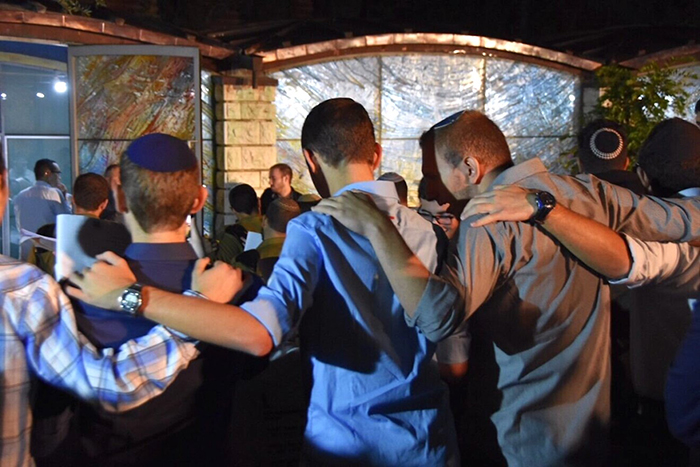
As many as 400 worshippers attended selichot services in the synagogue of Beit HaNassi, the official residence of the president of Israel, in the Talbiya neighborhood of Jerusalem on Sept. 27, 2017. Photo courtesy of Tomer Reichman/Spokesperson’s Unit of the President of Israel via Wikimedia Commons.
At last, the Hebrew month of Elul has arrived, the auspicious start of the High Holidays, when many Jews begin saying the penitential prayers of Selichot. For Sephardic and Mizrahi Jews, the holiday began on the second day of Elul (Aug. 26) and continues through the month of Elul; for Ashkenazi Jews, this year it takes place the Saturday night preceding Rosh Hashanah (Sept. 13).
Selichot, which means “forgiveness” in Hebrew, is arguably one of the most spiritually and emotionally inspiring services of the Jewish year—a time when we express contrition to God for our mistakes or failures during the past 12 months. But for many congregations, particularly in North America, it can be one of the least attended of holiday services.
Twentieth-century rabbinical scholars had an explanation for why this is so: the unusual hour at which Selichot is traditionally held. The wee hours of the night (typically, just before dawn) were believed by ancient Jews to be the best time to petition God’s favor. So Sephardic and Mizrahi Jews traditionally start the service very early in the morning. Ashkenazi congregations usually recite the prayers late at night on the last Saturday before Rosh Hashanah. Those are tough hours to gather a minyan (a public prayer quorum of 10 worshippers) for services.
Still, I wonder if the issue these days is less about schedule and more about how we relate to the topics of forgiveness and repentance.
A growing number of congregations in the last decade have begun exploring new ways to introduce their selichot services. Some have changed the venue to inspire opportunities for more reflection. An extension of this is Israeli musician David D’Or’s “Selichot Yerusalayim,” which has taken Jerusalem by storm in recent years.
Other congregations have combined efforts and funding so they can provide larger and more diverse musical experiences for their members. ome synagogues use interviews and personal stories to illustrate how an act of forgiveness can be a powerful motivator to personal growth and change.


Each year, Congregation Beth Israel in Vancouver, British Columbia, features a story about an individual (usually a celebrity) who has undergone a cathartic, life-changing experience. Rabbi Jonathan Infeld, who developed the program’s concept when he was an assistant rabbi at Ohev Shalom Synagogue in Marlboro, N.J., serves as its moderator. Each story in one way or another relates to how those individuals dealt with repentance, forgiveness, renewal or atonement—the key tenets of the High Holidays.
I met the rabbi while a congregant at Beth Israel, and while I no longer live in Vancouver, I continue to follow the program’s development. The message it carries fascinates me: Forgiveness and reconciliation can be a catalyst for self-empowerment and survival. Its success, I believe, isn’t just because the program features emotionally compelling stories about the experiences of well-known celebrities, but because it is able to show how these topics relate directly to the theme of Selichot, and potentially, to the life experiences of each of its audience members.
One of Beth Israel’s first guests was Vancouver resident Sherry Weiss, who was severely injured in a Hamas terrorist attack in Israel in 1997. According to Infeld, she saw forgiveness as an essential requirement for her to heal from the attack.
“In order to go on living her new life, she had to forgive” the unnamed terrorists that had maimed her, Infeld told me. But that didn’t mean she accepted that they had providence over her life. In an act of immense courage, she also sued Iran for its role in funding terrorism in Israel. Her story speaks not only to the painful, often incomprehensible decisions we’re faced with in order to heal, but the times in which we live.
For world-renowned Canadian track and field athlete Rick Hansen, CC, OBC, self-forgiveness has been the driving force to recovery. He was injured as a teenager in the 1970s when he rode unrestrained in the back of an open pickup truck. The truck flipped over, and the impact injured his spinal cord, leaving him paralyzed from the waist down.
According to Hansen, healing meant learning to move beyond his grief and anger and find a way to forgive himself for his mistakes. Those lessons became foundational to his recovery. Hansen went on to become an award-winning track and field athlete, competing in both the Paralympic Games and the Olympic Games. He is also recognized globally for his advocacy for people with disabilities and is the recipient of two of Canada’s highest honors: the Companion of the Order of Canada and the Order of British Columbia.
This year, the synagogue will host Neshama Carlebach, daughter of the influential Orthodox Rabbi Shlomo Carlebach (“The Singing Rabbi”). The interview will deal with an equally challenging High Holy Day topic: the complex intersection between her love for her father, her mentor and early role model, and the accusations of sexual abuse against him that surfaced after he died in 1994. Those allegations (which she says she was unaware of until after his death) have had a devastating impact on her reputation and career as a musician. The program will explore how she continues to balance her advocacy for the alleged victims, some of whom were teenagers at the time of the incidents, and her love of her father and his musical legacy.
Beth Israel’s Selichot program has existed for almost two decades, so it’s no surprise that audience turnout often reaches into the hundreds. The interviews and guest presentations have touched on a range of other topics as well: the Holocaust, restorative justice in the criminal system, the fate of the hostages Hamas has held captive in Gaza since Oct. 7, and the impact of online hate campaigns and social media (one of Beth Israel’s most well-attended events). Formal Selichot services are also a part of the program.
Selichot programs like this do more than prepare us for tackling the complex topics of High Holiday liturgy. They teach us empathy by recognizing our own struggles in the remarkable stories and accomplishments of strangers.