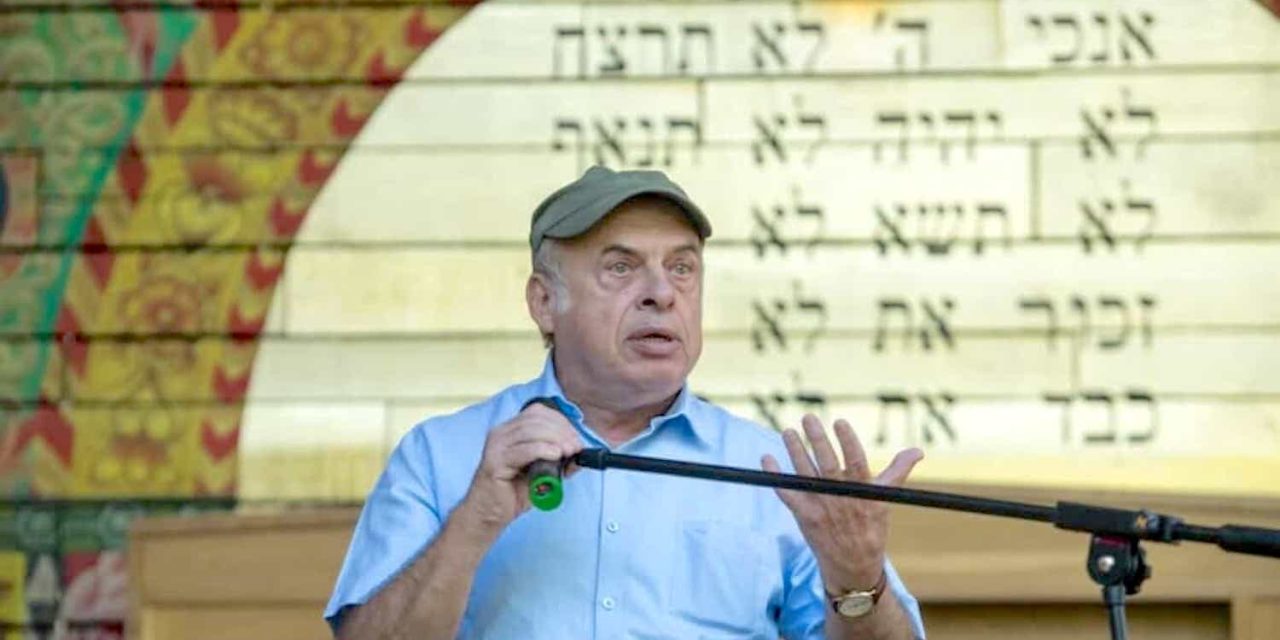

Natan Sharansky, the Babyn Yar Holocaust Memorial Center’s (BYHMC) chairman, speaks at the symbolic synagogue there in 2023. Photo courtesy of BYHMC.
By ALEX TRAIMAN
JNS
As Russia continues to pound Ukrainian cities, archivists are working underground daily to rescue and record Jewish history—page by page, name by name. According to former Jewish Agency Chairman Natan Sharansky, who today serves as chairman of the Babyn Yar Holocaust Memorial Center (BYHMC), the effort to digitize millions of Jewish records linked to Babi Yar has become a race against time.
“There are more than 20 million documents,” Sharansky told JNS in an interview at the Jerusalem Media Hub on Dec. 23. “We’ve already digitized nine million—during the war, under fire.”
“These documents are in the last moments of their life,” he added. “If we don’t save them now, they will be lost forever.”
Urgent Archive Effort
The project, launched alongside the Babyn Yar Holocaust Memorial Center, aims to preserve centuries of Jewish life in Ukraine—from 1796 through the Holocaust and beyond. Birth records, circumcision logs, court files and community registries are being scanned at 14 locations, some operating only a few hours a day because of power outages and bombardment.
The urgency of the archive effort is inseparable from Babi Yar (locally known as /Babyn Yar) itself. On Sept. 29–30, 1941, on the eve of Yom Kippur, Nazi Einsatzgruppen murdered approximately 33,000 Jews in a ravine outside Kyiv. Over time, more than 100,000 victims—Jews, Roma and others—were buried there.
“Babyn Yar is the biggest grave of the Holocaust and the biggest symbol of how the Soviet Union erased Holocaust memory,” Sharansky said.
Unlike Auschwitz, he said, Babyn Yar represents the “Holocaust by bullets.” Before gas chambers were devised, Jews across Eastern Europe were killed one by one—stripped, shot and buried in mass graves.


“There were no gas chambers yet,” Sharansky said. “This was the first experiment.”
The brutality even traumatized the perpetrators. “The soldiers who carried out the executions were given special leave afterward,” he said. “That’s when the Nazis decided they needed a more ‘efficient’ system.”
Hidden Massacre
After the war, the Soviet Union did not memorialize Babi Yar. It tried to erase it. “They wanted to turn it into a sewage site, then a stadium, then a park,” Sharansky said. “No mention of Jews. No mention of the Holocaust.”
He spoke from personal experience. Growing up in Donetsk, Sharansky lived near what he later learned was the second-largest Holocaust mass grave in Ukraine. “We played there as children and knew nothing,” he said.
Even attempts to mark Babi Yar were suppressed by the Soviet Union. “When I was a Jewish activist in Moscow, we tried to go there on the anniversary,” he recalled. “We were arrested on the way.”
Ukraine’s independence opened opportunity. “One of the first things independent Ukraine recognized was that the destruction of Babyn Yar was a Soviet crime,” Sharansky said.
In 2016, Kyiv officials and donors asked Sharansky—then head of the Jewish Agency—to help lead an international memorial initiative. He became chairman of its advisory board.
Before Russia’s invasion on Feb. 24, 2022, the project achieved major milestones, including the first synagogue ever built at Babyn Yar and a field of memory inscribed with victims’ names. Then the war halted construction.
Saving Our History
Out of that destruction emerged the archive initiative. With Ukrainian government backing, Sharansky’s team began digitizing Jewish records nationwide.
“In Kharkiv, sometimes they work two hours a day because there’s no electricity,” he said. “Some archives are already damaged.”
The project’s cost has risen to $3 million because of wartime conditions. Half has already been raised.
“Every $100,000 opens another city,” Sharansky said. “We are running against time.”
When completed, the archive will allow Jews worldwide to trace family histories stretching back centuries.
“Most Ashkenazi Jews have roots in Ukraine,” he said. “This belongs to all of them.”
Sharansky sees the archive effort as inseparable from Ukraine’s struggle for survival. “This is a war about freedom,” he said. “Ukraine is fighting for its existence.”
Despite the devastation, he remains convinced that history can still be preserved.
“If we lose these documents, we lose centuries of Jewish life,” Sharansky said. “Saving them is not only about the past. It’s about whether memory survives at all.”