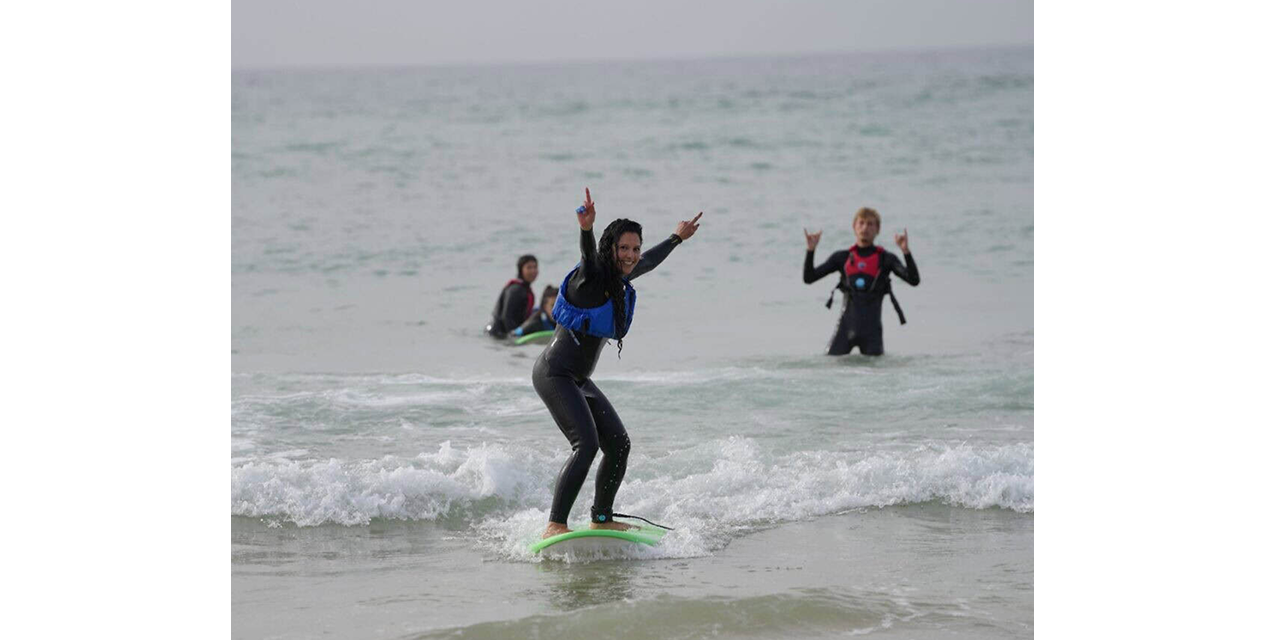
Participants in the HaGal Sheli healing program surf on the Mediterranean at Zikim, which came under attack during the Oct. 7, 2023 massacre, Feb. 12, 2026. Photo courtesy of HaGal Sheli.
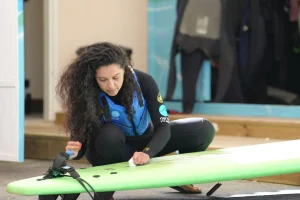
Michael Reichter, a participant in the HaGal Sheli program, prepares to surf in the sea, Feb. 12, 2026. Photo courtesy of HaGal Sheli.
By ETGAR LEFKOVITS
JNS
ZIKIM, Israel—For nearly a year and a half, Michal Reichter stared at the Mediterranean Sea from her first-line beach home in her southern Israeli agricultural community, but dared not approach.
“The sea is my home, but I would not agree to come near it,” said the 46-year-old resident of Kibbutz Zikim, three miles north of Gaza. The trauma of the Oct. 7, 2023, Hamas-led attacks—still fresh in her mind even after nine months of being evacuated from her southern Israel home—simply overpowered her.
Now, the same sea that she so feared is healing her fears.
‘A Beach Of Rebirth’
It was three months ago that a neighbor connected Reichter with HaGal Sheli (Hebrew for “My Wave”), a 12-year-old Israeli non-profit organization that was once known for healing at-risk youth through surfing, but which post-Oct. 7 began dealing primarily with helping southern Israel residents traumatized by the attack, which triggered the two-year war in Gaza, recover through the sport.
Built During The War
The beach at Zikim had been declared a closed military zone and was shuttered for two years following the Oct. 7 attack when 38 Hamas terrorists in seven speedboats set out from the nearby Gaza Strip, murdering 17 civilians and one soldier on the beach but were repelled by Israeli security forces and the community’s rapid response team from entering the adjacent kibbutz where residents were holed up inside safe rooms.


Israel’s southernmost beach reopened last October with the ceasefire in Gaza, and with it a new surfing center run by the nonprofit constructed during the war so that it would be ready timed with the beaches’ reopening.
“This is going to be one of the major centers of rehabilitation in southern Israel,“ said Yaron Waksman, founder and CEO of HaGal Sheli, whose college-time idea with a friend a decade and a half ago of combining their passions of educating at-risk youths and surfing led to the creation of the organization.
After over a decade of dealing with complex trauma in thousands of at-risk youth, about 60 percent of their current activity is now devoted to acute trauma caused by the attack, he said. 1,500 participants, including residents, bereaved family members and reservists, are expected to attend the program at this site alone this year, one of 12 such centers across Israel.
The group receives a third of its $7 million annual budget from the government, one-third from selling services, and one-third from donations.
“We wanted the beach to be a beach of rebirth for the residents and not one of destruction,” said Shir Ariel, 28, who manages the new surf center at the beach for the nonprofit.
Ariel, a social worker and avid surfer herself, said that the group, which sprang into action in the very first days after the Oct. 7 attack, assisting evacuees with therapy and free surfing lessons to help them ease their trauma had no idea just how great the demand would be, with some even on waiting lists to join.
“We know that in the coming decade, we are going to be very much in need,” she said. “I have seen this place cure souls.”
Effort To Overcome Trauma
“This has changed me completely,” said Reichter, the kibbutz member who long struggled with the memory of being stuck in an unlocked safe room with her two children for 13.5 hours as the sound of gunfire whisked outside their window while the kibbutz security force fought off the terrorists. “It took me a long time, but I fought with myself and I told myself I have to fight to overcome this fear.”
It is a fight still in progress.
Discovering Strength
“Even when I am in the water, I see Gaza with my eyes,” she said. “I am frightened; I am under pressure, but I am here.”
Other residents and program participants told of a similar response.
“I came with tremendous fear, and this is the best thing I have done for myself,” said Maya Gantz, 47, of Zikim, who was home alone with her four children at the time of the Oct. 7 attack, her eldest teen armed with knives while her husband was fighting outside with the first response team. “The staff here is able to cause you to discover your own strength in a way that a psychologist does not succeed in doing.”
The 15-week course, running over three-and-a-half months, integrates trauma-focused therapy with surfing. Each session is guided by a professional team of psychologists, social workers, and expert surf instructors.
“I got on the surfboard without any knowledge, and even if you fall in the water, it fills you up with a tremendous drive,” she said.
“I have seen how much the sea can cure and does good for the participants and I am filled with positive emotions from them,” said Omri Negev, 37, an electrical engineer at Ben-Gurion International Airport who is one of the volunteer surf teachers at the site. “The sea healed me, and I know it will continue to heal others.”