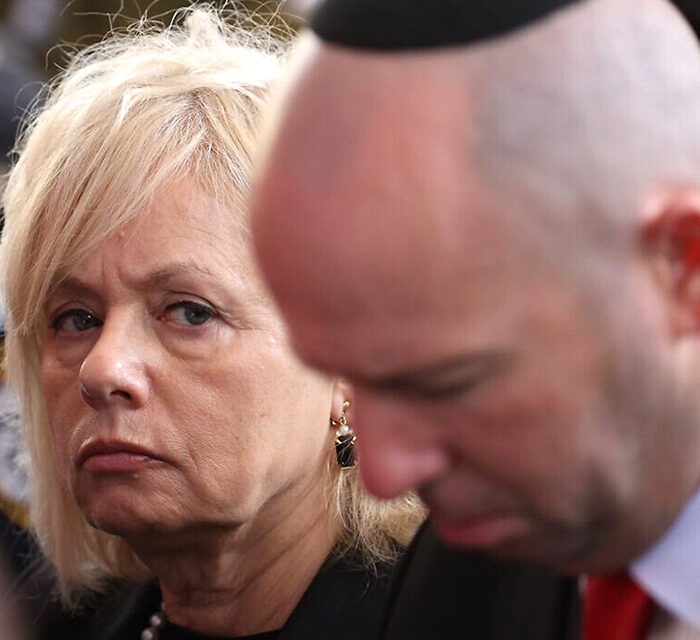
Attorney General Gali Baharav-Miara attends a state ceremony marking the Hebrew calendar anniversary of the Oct. 7, 2023, Hamas-led terrorist invasion, at the Mount Herzl Military Cemetery in Jerusalem on Oct. 16, 2025. Photo courtesy ofAlex Kolomoisky/POOL.
JNS
Israel recently has been become embroiled in a convoluted political scandal.
Israel’s military advocate general, Maj. Gen. Yifat Tomer-Yerushalmi, admitted that she had personally authorized and amplified the release of security footage from the Sde Teiman Prison. The video surfaced in July 2024, showing IDF reservists allegedly sexually abusing a Gazan detainee at the site.
The footage, later leaked to Channel 12, prompted public outrage, the indictment of several soldiers, and riots in which demonstrators stormed the Sde Teiman base and the Beit Lid military court where the reservists were taken.
Tomer-Yerushalmi said she leaked the material “to fend off public criticism that culminated in right-wing mobs storming Sde Teiman and the Beit Lid military court.”


Defense Minister Israel Katz had pressed for her dismissal, but Tomer-Yerushalmi resigned before he could remove her from the post.
Police subsequently opened an investigation. Tomer-Yerushalmi is suspected of obstruction of justice, fraud, breach of trust, abuse of authority and concealment of evidence.
“This is an unprecedented violation of the public trust that has not been seen in years,” an official from the Justice Ministry told JNS. “The army is one of the foundations of the State of Israel, and the idea that a commander whose responsibility is to protect soldiers and shield them from international law is herself involved in spreading the smears that attack them is unbelievable,” she added.
Suspicious Developments
On the Sunday following her resignation, Tomer-Yerushalmi disappeared along the Tel Aviv coastline. Her car was found abandoned on the beach, and police launched a search, fearing she had attempted suicide to destroy evidence. She was later found on Herzliya Beach and referred for psychiatric evaluation. Investigators said the circumstances suggested “an elaborate scheme to destroy her phone in the Mediterranean Sea.”
Five days later, a civilian discovered her missing cell phone on the seafloor off Cliff Beach in Tel Aviv. Police cyber-unit specialists confirmed ownership and began extracting data from the device.
Following several days in custody, the Tel Aviv Magistrate’s Court released Tomer-Yerushalmi to 10 days of house arrest, barred her from contacting others involved in the case for 55 days, and required her to obtain police permission before meeting her legal team. She posted 20,000 shekels (about $6,200) bail, and police later sought additional restrictions, including a travel ban and surrender of her passport.
Then she was hospitalized at Tel Aviv’s Ichilov Hospital after ingesting sleeping pills. “She is conscious,” a hospital spokesperson said, adding that authorities were examining whether the incident had a suicidal background. Police said she remains fit for questioning and that her condition does not interfere with the ongoing investigation.
According to police, “since the first remand extension, the investigation team has taken dozens of actions. As a result of these actions, the suspicion has been strengthened. … The suspicion of obstruction by the suspect persists throughout the investigation.”
A spokesperson added that “at all times, there has been a culture of silence among the immediate circle of the suspect.”
AG Pushed Away
On Oct. 31, Attorney General Gali Baharav-Miara ordered the opening of a criminal investigation into the leak of the Sde Teiman video.
The next day, Justice Minister Yariv Levin announced that he was barring the attorney general from involvement in the case and assigning oversight to retired judge Asher Kula, the public complaints ombudsman for judges.
In a formal letter, Levin wrote that he had already informed Baharav-Miara she was “disqualified from handling the case, which includes the leaking of the video from the Sde Teiman base and obstruction-of-justice offenses being investigated as a result.” He said a temporary acting appointment was needed for all matters related to the AG’s authority in this file.
Levin outlined criteria for the replacement: “knowledge and experience in criminal law, full independence, non-subordination to actors in the judicial system, and institutional capacity … alongside broad public trust.” He said Kula, “personally and institutionally, meets all the requirements, and his appointment will receive the public trust required at this complex time.”
Levin argued that Baharav-Miara and her subordinates were too closely tied to the leak investigation, accusing her office of having provided “misleading information to the Supreme Court” when representing the Magistrate General’s Office.
He maintained that “the Ombudsman for Judges, both as an institution and personally, is the best possible solution, … His appointment will enjoy broad public trust.” However, the minister’s authority to displace the AG was disputed.
Baharav-Miara rejected Levin’s order. In a Nov. 2 letter, she said Levin’s “political involvement in the investigation was erroneous, baseless and harmful.” Her deputy, Gil Limon, wrote that the minister “does not have the power to transfer enforcement powers to another civil servant.”
Levin replied that he “rejects outright everything [Baharav-Miara] says.”
On Nov. 6, Justice Ministry legal adviser Yael Kutik issued a formal opinion concluding that the attorney general indeed faced a potential conflict of interest.
Kutik wrote that “at this stage, the attorney-general must refrain from participating in overseeing or supervising the ongoing investigation due to the potential connection between this investigation and the process of examining the leak she had been responsible for overseeing.”
She added that the guidance “is not intended to question Baharav-Miara’s conduct, but rather to ensure the investigation’s independence, even if only for the sake of appearance.”
Kutik warned that the investigation’s scope was still developing and that “it is therefore possible that, alongside investigating the leak itself, the police will also consider whether the investigation team knew of, or turned a blind eye to the possibility that the military prosecutor was involved in the leak.” If that line of inquiry were confirmed, “there may be a need to question those who oversaw the investigation team,” including officials within the Attorney General’s Office.
Following the opinion, Baharav-Miara reconsidered her position. Sources said she was “leaning toward stepping aside from the investigation” and would turn responsibility over to State Attorney Amit Aisman.
Later that day, Baharav-Miara transferred the investigation to the military prosecution.
Allegations Of ‘Deep State’
Levin’s opposition to the AG overseeing the investigation into Tomer-Yerushalimi rests primarily on a broad governmental consensus that she herself is implicated in the leak scandal. Before police launched their criminal investigation, Baharav-Miara had already overseen a separate internal probe, conducted by Brig. Gen. Gal Asael, who did not link Tomer-Yerushalmi to the leak. Coalition lawmakers cited that failure as evidence of a cover-up.
The coalition’s narrative is strengthened by the fact that, according to reports, “the investigation was triggered by intelligence from a security agency.” Most assessments indicate the Shin Bet was the source of the intelligence mere days after Netanyahu-aligned David Zini entered his new role as head of the service. This fact demonstrates that personnel in the higher echelons of Israeli law enforcement were aware of Tomer-Yerushalmi’s involvement in the leak, indicating a cover-up at some level.
“There is a tie between the Office of the Attorney General and the Sde Teiman case. Her office investigated and claimed to find nothing. The idea that the person who, in the best case, failed to uncover the truth the first time, should now be trusted to investigate again is unacceptable,” an official from the National Security Ministry told JNS. “Since the start of this case, there has been one odd thing after another. The attempt to get rid of her phone already shows that something suspicious is going on,” he added.
Likud MK Moshe Saada, a former deputy head of the Israel Police’s Department of Internal Investigations, alleged that Baharav-Miara knew of Tomer-Yerushalmi’s role in leaking the Sde Teiman footage.
“Everyone together leaks a recording that leads to a blood libel against the State of Israel and the Jewish world, creates anti-Semitism and hurts heroic soldiers,” he said. “It’s very much a criminal organization, … and who is covering for this criminal organization, who is allowing it? Gali,” he added, referring to the AG.
Saada called for the arrest of everyone involved, “from end to end,” and criticized the fact that Asael, who oversaw the earlier internal probe that did not implicate Tomer-Yerushalmi, had not been detained.
At an Otzma Yehudit Party faction meeting, National Security Minister Itamar Ben-Gvir alleged that Tomer-Yerushalmi’s missing cell phone might implicate the attorney general.
“As I speak, a woman is sitting at the Justice Ministry and shaking from fear; she’s afraid that the phone will be found. It is clear to all that it has evidence on it that implicates her in serious crimes. This woman is named Gali Baharav-Miara,” he said. Ben-Gvir added that she was “neck-deep in this affair,” claiming she had acted “so that the deep state’s status won’t be harmed.”
Regarding the recovered device, he remarked, “The MAG lost her phone, not for naught. It is clear to all that when the materials on this phone are revealed, there will be an earthquake …, the earth under the deep state will shake.”
As the political dispute deepened, Baharav-Miara and other law enforcement officials declined to attend a Knesset Constitution, Law and Justice Committee hearing, citing the ongoing investigation. In a letter to committee chair MK Simcha Rothman, she said that “no law enforcement officials would be able to attend for fear of interfering with the investigation.” Israel Police Deputy Commissioner Boaz Blatt also did not appear.
“I don’t know whether I’m happy or sad that the deep state and its representatives in the Knesset decided not to show up,” Rothman said. He accused investigators of “contaminating the investigation” and called the situation “tragic.”
The rift extended to the police. sSenior officers refused to hand over investigation materials to Judge Kula until the High Court ruled on his authority. A law-enforcement source told Channel 12 that commanders in the police said they were attempting to stop the government from “trampling democracy.”
Police Chief Danny Levi and Investigations head Blatt insisted that Kula’s appointment must first be approved by the court, even though the court had not issued an injunction against his appointment.
Ben-Gvir condemned the police for defying the government’s instructions. “I’m not interfering in the investigation, but the decision of who will supervise and oversee the investigation lies solely with the government. We are not a banana republic,” he told police commanders. He warned that “anyone who transgresses the law and damages an investigation for improper reasons will be punished.”
The legal battle over Attorney General Gali Baharav-Miara’s role in the Sdei Teiman affair has now reached Israel’s highest court.
A petition filed by MK Avichay Buaron (Likud) and the Lavi Organization through attorney Itzik Bam demands that Baharav-Miara be removed from managing any processes related to the investigation, alleging she “may have been involved in the case and its handling, and is therefore unfit to lead the investigation.”
At the same time, the Movement for Quality Government in Israel filed a counter-petition to the High Court, seeking an injunction against Justice Minister Levin’s effort to sideline the AG, arguing his interpretation of the law “has not even the faintest foundation” and that “it is unacceptable that in a democratic country a minister … decides of his own accord … to harm the authority of the attorney general on criminal matters.”