
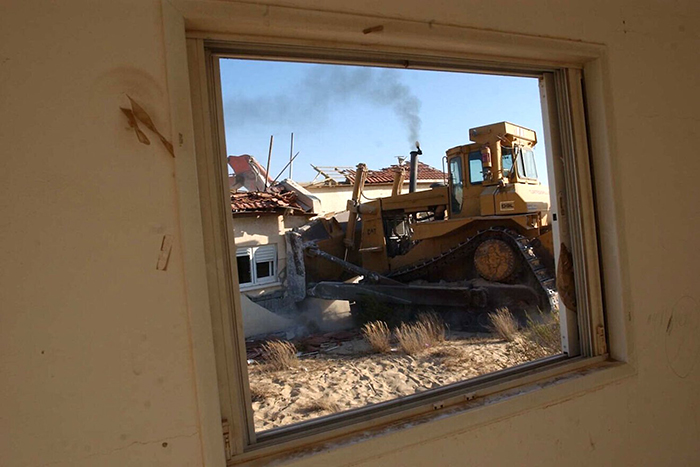
Israeli tractor demolishes a house during the disengagement of Gush Katif, Aug. 21, 2005. Photo courtesy of Flash90.
JNS
Calls from Israeli Finance Minister Bezalel Smotrich and others to “reoccupy” the Gaza Strip reveal a dangerous nostalgia for one of the most disastrous chapters in Israeli history—a longing that commanders in the Israel Defense Forces, with bitter experience, do not share. Yet Israeli Prime Minister Benjamin Netanyahu appears willing to disregard their warnings and order troops back into a no-win situation in which the hostages may be sacrificed, the nation’s moral standing further eroded, international pressure for a Palestinian state intensified, and Israeli citizens left insecure.
Good Old Days?
Let’s recall what those good old days of occupation looked like. Unlike Judea and Samaria, Gaza was not part of the biblical Land of Israel; it was taken from Egypt in 1967 and considered by most Israelis a strategic burden rather than a birthright. Israel would have gladly returned it to Egypt, but that country didn’t want to be stuck with responsibility for the Palestinians.
In the five years immediately before the 2005 disengagement, when Israel withdrew its troops and dismantled Jewish communities in Gaza, some 130 suicide attacks—mostly by Hamas and Palestinian Islamic Jihad—were carried out, with 159 more foiled in 2004 alone. Not all violence originated from the Strip since these were the years of the Second Intifada, but many of the more than 1,000 Israelis were killed by terrorists from Gaza.


For example:
- June 22, 2001:Two 19-year-old IDF sergeants were killed near Dugit in Gaza when a booby-trapped jeep exploded; Hamas claimed responsibility.
- Jan. 14, 2004:A female suicide bomber killed four Israelis and wounded 10 at the Erez Crossing in Gaza; Hamas and Fatah’s Al-Aqsa Martyrs Brigades claimed joint responsibility.
- Dec. 7, 2004:An IDF canine-unit sergeant and his dog were killed by a booby-trapped chicken coop near the Karni border crossing in Gaza; four soldiers were wounded. Hamas claimed responsibility.
- Jan. 12, 2005:One civilian was killed and three soldiers were wounded by a roadside bomb near Morag in the southern Gaza Strip; Islamic Jihad claimed responsibility.
- Jan. 18, 2005:A suicide bomber at the Gush Katif junction in Gaza killed an Israeli Security Agency officer and injured eight others; Hamas claimed responsibility.
Hamas and PIJ did not start firing rockets after Israeli troops left Gaza. More than 500 were launched between 2001 and the withdrawal in August 2005. In 2004 alone, Palestinians fired 882 mortar shells and 276 Qassam rockets, killing eight and wounding 99 people.
In addition to the human cost, the occupation contributed to Israel’s public relations problems, which, unlike many might think, did not start following Oct. 7, 2023.
If we go back further—before Israel agreed to give the Palestinians civil control over their affairs in Gaza as part of the Oslo Accords—the military administration was responsible for the welfare of the Gazans for nearly 30 years. No one wants a return to that situation.
Why did Ariel Sharon, the father of the settlement movement, decide to leave Gaza?
First, since it was not part of the Land of Israel, there was no religious connection to justify its coming under Israeli sovereignty.
Second, Sharon hoped to separate from “Palestinian” Arabs. This was no concession to terror; he knew that Israel could not be both Jewish and democratic if it absorbed the West Bank and Gaza’s population. He also hoped to reduce friction with Arabs, cut expenses required to protect and sustain the 9,000 settlers, redeploy troops needed to defend them, and “reduce terror as much as possible and grant Israeli citizens the maximum level of security.” He sought this while strengthening Israel’s hold on strategic parts of Judea and Samaria that would “constitute an inseparable part of the State of Israel in any future agreement.”
Third, this was a time when another American president was pressuring Israel to accept a Palestinian state. Sharon knew that Israel could not achieve the same level of security in talks with the intransigent Palestinians that it could through unilateral action. He said he wanted the Palestinians to govern themselves, but Israel could not wait for them to agree to peace before taking steps to protect its citizens.
Netanyahu, it’s worth remembering, voted four times for disengagement. It wasn’t until about a month before it was implemented that he resigned as finance minister—a move some believed was motivated by political expediency (as many believe explains his actions over the last two years) and his belief that Sharon was vulnerable to being challenged for the leadership of the Likud Party.
The principal argument made by Netanyahu and other opponents was that Gaza would become a “base of terror” if the IDF withdrew. Troops would have to return, neighboring communities would be endangered, and the world would condemn Israel for acting unilaterally rather than applaud it for ending the occupation.
In hindsight, most people say the critics were correct. Terror increased dramatically almost immediately after the disengagement and culminated on Oct. 7.
Who To Blame?
But was the disaster inevitable? No.
The blame falls first and foremost on the Palestinians, who squandered the chance to build their state. After decades of hearing the mantra that Israel must trade land for peace, the hypothesis was put to the test. By maintaining calm, they could convince Israelis they were partners for peace and that Israel could afford concessions on the West Bank. The international community showered the Palestinian Authority with billions in aid to achieve self-sufficiency, and Israel left behind greenhouses that offered Gazans an instant export bonanza.
Instead, the Gazans immediately turned to violence. They bombarded Israel with rockets. Suicide bombings continued. Not one cent from the financial aid was spent to move a single refugee out of the camps that bred despair and terrorists. Hamas either torched the greenhouses or turned them into bases. Hospitals, schools and mosques became arsenals and command centers.
In 2006, Hamas won the Palestinian legislative elections. The following year, Mahmoud Abbas faced his Abraham Lincoln moment when he had to decide whether to allow Hamas to take over Gaza or to fight to keep the Palestinians unified. Unlike Lincoln, He took the coward’s way out and surrendered Gaza without a fight. This exacerbated a split among Palestinians that all-but-guaranteed the end of a two-state solution since Israel could never accept a government that included Islamists sworn to its destruction. By proving the land for peace formula was a fantasy, the Palestinians shifted Israeli opinion to the right, destroying the peace camp and the illusions of Oslo.
Israel is not blameless. Netanyahu turned his warning into a self-fulfilling prophecy. He has served as prime minister for roughly 20 of the 25 years since disengagement. And as much as he wants to deflect responsibility, he cannot escape the fact that it was on his watch that Iran armed and funded Hamas, and that he was the one who approved the Qatari transfer of millions of dollars in cash the Islamists used to prepare for Oct. 7.
Ehud Olmert, Sharon’s immediate successor, launched “Operation Cast Lead” at the end of 2008 to end the escalating rocket attacks. Anyone who was surprised by the international reaction to the current war should read the coverage of that operation. The 22 days of fighting, which included a ground operation, were largely seen as a success: Israel degraded Hamas’s ability to fire rockets; Israel sustained far fewer fatalities and injuries than anticipated; attention was brought to Hamas’s tunnel network; and moderate Arab leaders (except Qatar’s) did not support Hamas. Olmert, however, did not try to drive Hamas from power, and that proved a mistake as rocket and terror attacks resumed, leaving his successor, Netanyahu, to rectify the error.
Full Circle?
Until Oct. 7, Netanyahu feared that the public would not support a ground war because of the high number of casualties expected in the urban environment they would encounter in Gaza. Hence, after mobilizing reservists in 2012, he declined to authorize a ground incursion during “Operation Pillar of Defense.” The eight days of fighting did not eliminate the threat posed by Hamas and were the first of four operations (“Protective Edge,” “Guardian of the Walls” and “Shield and Arrow”) that involved “mowing the lawn”—that is, the short-term degrading of Hamas’s capabilities primarily through airstrikes.
A total of 1,469 rockets were launched into Israel during the four days of Israeli airstrikes targeting PIJ commanders in the last operation before the massacre. By this time, it was evident that Israel could not deter or defeat Hamas without a large-scale ground invasion. Presciently, the head of the IDF Operations Directorate, Maj. Gen. Oded Basiuk, stated that while Israel had accomplished its objectives, “Gaza is Gaza; there is an ongoing war on terror, and it probably isn’t going to end. We’ll have to operate in Gaza in the future, too.”
Don’t be surprised to hear another IDF general make a similar statement when the current fighting ends and the reoccupation of Gaza brings Israel full-circle to the position it was in 20 years ago.