

Adam Furgang
Garage sale Jewish treasures help me as I find my way back after Oct. 7
By Adam Furgang
Artist and writer Adam Furgang lives with his wife and sons in Colonie
Like many Jews living comfortably in the U.S., I was shaken awake after Oct. 7, 2023. Since then, I’ve re-examined my Jewish identity from multiple angles—and I’ve had the most fun doing this while hunting for old Judaica.


As long as I can remember, I’ve been passionate about collecting. Growing up in Queens, New York, the son of a Jewish antique dealer, the urge to acquire things that connect to my passions runs deep.
My father, Sam, got into the family antiques business in 1968, by accident and necessity. He went to his dad’s antique store on the Lower East Side of Manhattan one Sunday afternoon to help out, when his mom was not feeling well. He quickly caught the antiquing bug. He worked there for 27 years until that store closed in 1995. Then he ran Antique Alley on Northern Boulevard in Little Neck, Queens, until retiring in 2003 at the age of 60.
The family antiquing operation on the Lower East Side began in 1935 when Mayor Fiorello LaGuardia decided to push pushcarts from the streets. A pushcart business had supported my grandfather, Murray, a Jewish immigrant from Poland, for nearly four years as he sold trinkets, jewelry, and household items.
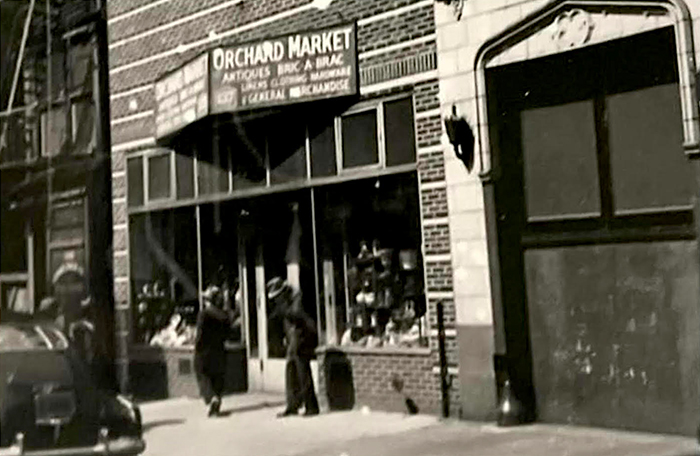
Orchard Market
As the campaign to remove pushcarts intensified, my grandfather joined others in 1935 to open a large antique store on Rivington Street, in a building known in the 1920s as the Ruby Theater. They chose the name Orchard Market to capitalize on the popular Orchard Street market business and benefit from its traffic.
After a fire gutted the store on Rivington Street, the dealers moved to Ludlow Street and renamed it the Antiques Market in 1939. My father eventually became the last dealer left in the store until it closed in 1995. I was initiated at this shop, between Stanton and Rivington Streets, down the block from the famous Katz’s Deli. The exterior of the store is visible on the vinyl gatefold panorama of the Beastie Boys album Paul’s Boutique.
With many dealers, the business offered a wide variety of secondhand items — furniture, China, clothing, silverware, jewelry, watches, compacts, and costume accessories. Since many of the dealers were Jewish, it also offered Judaica– candlesticks, kiddush cups, menorahs, Shabbat candle holders, and mezuzahs.
As I observed my dad buying, selling, and negotiating, the collecting bug inevitably bit me. My first targets were toys like Micronauts, LEGO, action figures, Matchbox cars, and Star Wars toys. This quickly expanded to comics, trading cards like Wacky Packages, and skateboard stickers
At home, I grew up surrounded by items from the past. Many modern things that came into our house were often secondhand. Art supplies, toys, microscopes, and many other things I loved growing up were often acquired used. My first CD player in the ’80s… used. An Intellivision video game system with games… also used.
Art, seriously
The antiques business influenced my career, as in my teens I became interested in art, starting with comics and expanding into illustration and fine art—things that fascinated me as my dad bought and sold them. I was surrounded by countless examples of craftsmanship, art, history, and design. As my interest in art became serious, I went to the High School of Art and Design. This NYC vocational school prepared me for college at the University of the Arts and work as a commercial artist and designer.
Decades before eBay and Facebook Marketplace, I thrilled to hunt and buy cool stuff at a discount, sometimes in near-perfect condition.
The skill of selling items, too, eventually rubbed off on my brother and me. We learned that not everything needs to be kept forever. Many things are transient. Toys and gadgets I treasured as a child I sold in my teens for pocket money.
In my early teens, my brother and I even ran impromptu clandestine garage sales at our house when our parents were away, unloading toys, games, and clothes to earn money to go out—or buy more stuff. We even sold a desk that wasn’t ours.
Today, this kind of exchange has become mainstream, but for a long time selling used goods was a niche skill. I’m still always looking for cameras, old toys, records, cassettes, Walkmans, comics, and– most recently—Judaica.
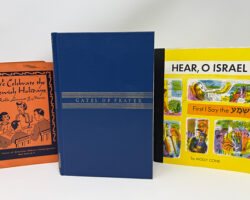
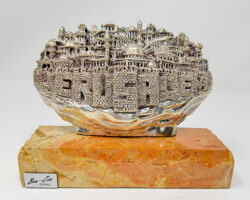
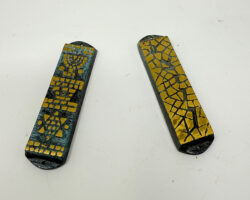
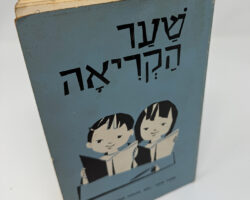


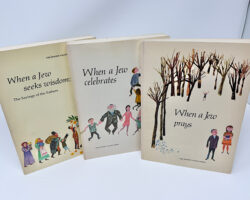
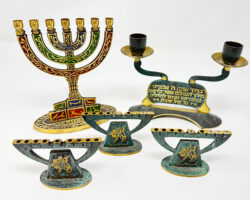
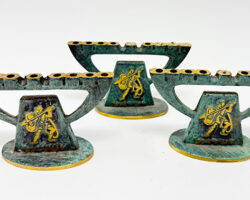
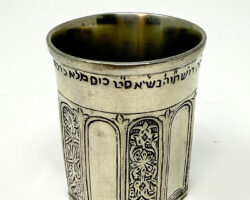
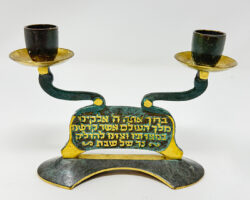
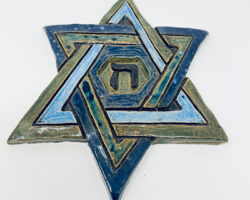
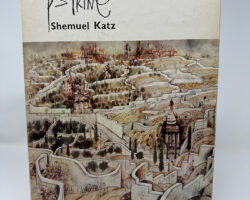
Books, mezuzot, candelabras, and other treasures turn up on garage sale tables
A new pressure
After Oct. 7, 2023, I’ve reconnected with some old friends, made new ones, and lost others. The desire to reconnect with my Jewish heritage was suddenly critical and quickly became a discovery of what had become mostly lost knowledge for me. My ability to read Hebrew, which I was dutifully taught back in Hebrew school, is now almost entirely gone. Gone, too, were many of the Jewish accoutrements that I possessed growing up, such as a siddur (prayer book), a menorah, kiddush cup, kippah (yarmulke), mezuzah, dreidel, and more.
Fortunately, I had my dad to lean on for Judaica. He already had a stash of mezuzahs as well as a kiddush cup to pass along. And because he visits garage sales as often as teens check TikTok, I was able to give him a wish list of things I wanted to help me with my journey back to Judaism.
After I put out a call for books about Israel, Hebrew, siddurs, and more, the books he’d find at local garage sales started quickly flowing my way. I had to ask him to stop—there were just more books on Judaism than I could hope to read. A book by Alan Dershowitz contained a hand-typed letter from Dershowitz, printed on Harvard Law School letterhead. The letter was apparently forgotten inside the book before it was sold at a garage sale.
The irony of the book’s topic (The Vanishing Jew) and my mostly secular American existence was not lost on me. As I write, I’m still struggling with my re-emerging Jewish identity. This is the identity I was ready to shed in my teens. I realize what a mistake that was and am trying to make up for lost time. Where do I belong? Should I join a temple? How much prayer should I incorporate into my adult life? Gathering Judaica and books about Judaism from garage sales has been a huge help for me. Some might say just visit a library, but I’d rather have books pile up all around me that I own.
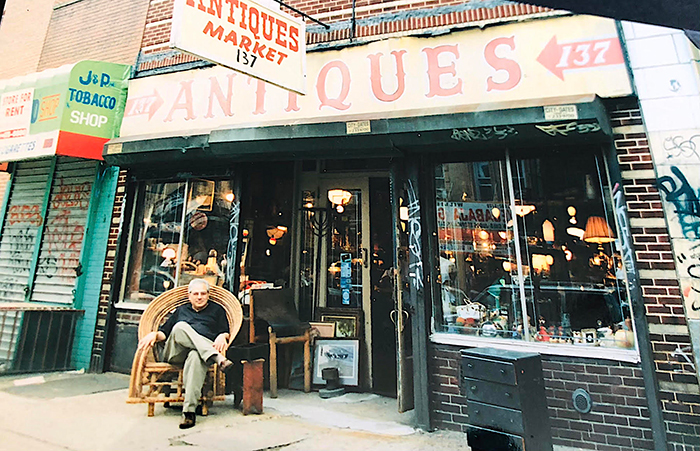
Dad in front of the store, lower East Side
Lighting candles
As I tried to re-establish a sense of connection to my lost heritage, one of the first Jewish rituals I reintroduced into my life was reciting the Shabbat prayers with my wife on Friday evenings at sundown.
After reading books about Judaism for a while, I finally felt ready, after a long year, to reach out to the local Jewish community. This was a good step, and I have made new friends along the way. After connecting with a Chabad rabbi, I purchased my first tefillin and began reciting daily prayers.
In addition to asking my father to keep an eye out for Judaica, I began acquiring books and items myself, too. I ordered several menorahs online for Chanukah—some new, some vintage. I bought a beautiful Metropolitan Museum of Art Kiddush cup reproduction on Facebook Marketplace and also ordered a handmade wedding band from Israel inscribed with: יברכך ה’ וישמרך
Yevarechecha Hashem V’yishmerecha – May G‑d bless you and guard you.
One evening this past winter, while browsing Facebook Marketplace, I came across a tiny Torah scroll for sale for very little money. I quickly contacted the seller and drove to Troy, to meet in the freezing cold in a Stewart’s parking lot to acquire the miniature scroll. The more I looked, the more I found. The universe is funny—soon, mezuzahs were turning up everywhere.
Most recently, my mother sent me a photo of a table filled with Judaica at an estate sale in Menands. I couldn’t see everything clearly in the photo, so as soon as I finished work, I went over to get a better look. I picked up Israeli candle holders, more mezuzahs, three miniature menorahs, and several books—including Israel’s War of Independence by Netanel Lorch and another wonderful look back in time—Israel Today, from 1968.
These things make me pause to consider the lives of the people who were their previous owners. Every book and item meant something to someone. In many cases, that person has passed away. I realize that as I look at the sometimes old and tattered items. I’m also happy to help save some items from bookshelves, boxes, and probably landfills – and give them new life.
I have been slowly reading the books. Much of the Judaica now has a place on my mantle, with the Shabbat candles and kiddush cups arranged on the kitchen table. Other items are reserved for holidays.
The search goes on. More Jewish treasures, books, and ritual objects are out there, waiting to find their way into my hands. I am hoping to find a seder plate before Passover.