
Babyn Yar massacre victims Esfir Ulanovskaya and her son, Adolf Ulanovsky. Photo courtesy of BYHMC.
By STEVE LINDE
JNS
The Babyn Yar Holocaust Memorial Center (BYHMC) recently revealed the names of more than 1,000 newly identified victims of the notorious Babi Yar massacre, which were announced publicly for the first time at an 84th anniversary ceremony held at the site in Ukraine.
“The breakthrough, made possible through unprecedented archival access and large-scale digitization despite the ongoing war, sheds new light on one of the Holocaust’s worst single atrocities—the murder of 33,771 Jews over two days in September 1941, the start of the ‘Holocaust by Bullets,’” it said in a press release.
Memory—A Moral Weapon
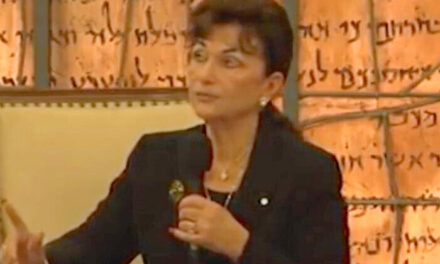
In Jerusalem, BYHMC and March of the Living hosted a parallel memorial at the National Library of Israel, where the newly discovered names were also read out. Speakers included BYHMC Chairman Natan Sharansky, Ukraine’s Ambassador to Israel Korniychuk Yevgen and Yad Vashem Chairman Dani Dayan.


“Memory is a moral weapon against denial, oblivion and distortion,” Sharansky declared. “Every name we succeed in restoring contributes to Holocaust commemoration and advances justice and dignity for its victims. Precisely in times of war, the obligation to defend the truth is doubled.”
Yevgen thanked Sharansky, in his role as chairman of the supervisory board of the Babyn Yar Holocaust Memorial Center, for working together with the Ukrainian government to maintain the site as well as the memory of the massacre and its victims with dignity.

Natan Sharansky, BYHMC’s chairman, at the symbolic synagogue founded by the Memorial Center in Babyn Yar, 2023. Photo courtesy of BYHMC.
Some Oppose Comparisons
“Let’s do everything we can in order to preserve the history and prevent such atrocities from happening again,” he said in English, comparing the Nazi horrors at Babi Yar to Russia’s invasion of Ukraine on Feb. 22, 2022, and the Hamas massacre against Israel on Oct. 7, 2023. “We have been passing through the era of the new Nazis,” he stated.
For his part, Dayan said he strongly opposed comparisons between the Holocaust and other historic events, even when they are made by Ukrainians and Israelis. “We have to say, ‘The Shoah is the Shoah … and the Nazis are the Nazis,’ and every attempt to ascribe this description to others diminishes the Holocaust.”
Personal Stories
Despite the ongoing war in Ukraine, BYHMC researchers said they had restored the identities of 1,031 people previously lost to history. The BYHMC database now contains nearly 30,000 names, enriched with details such as ages, relatives, professions and circumstances of death.
Victims ranged from a nine-month-old baby to a 102-year-old woman, underscoring the indiscriminate nature of the massacre, it said.
On Sept. 29–30, 1941, Nazi forces and their collaborators shot dead 33,771 Jews at Babi Yar in just two days. Over the following two years, the ravine outside Kyiv, Ukraine’s capital, became the largest mass grave in Europe, where some 100,000 people—including Jews, Roma and Ukrainian prisoners—were slaughtered.
Among the newly discovered materials are applications to adopt children orphaned after their parents were murdered at Babi Yar, petitions by citizens seeking legal recognition of relatives’ deaths for inheritance, remarriage or financial support, and birth certificates from the 1920s and 1930s that helped identify children murdered alongside their parents.
One striking case, BYHMC noted, is a 1946 legal file detailing the plea of Zindel Kravetsky, who sought recognition of the deaths of his wife and three children—Aron, 8, Zoya, 6, and Vova, 4—murdered at Babi Yar.
Another new story was that of Yankel Danilovich Krakovitz, who was born circa 1880 in the city of Bakhmut. After the 1917 Russian Revolution, he and his wife, Leah, moved to Kyiv with their four sons.
When the Nazis invaded, the family was offered an escape but chose to remain. Neighbors last saw Krakovitz in Sept. 1941, walking with a suitcase toward Babi Yar.
Another record documents the case of Rakhil Meirovna Kravets, born in 1863, who fled Korosten to Kyiv at the outbreak of World War II, only to be murdered in what a BYHMC press release called “the blood-soaked ravine.”
Since the Russia-Ukraine war began, more than 2,000 existing records have been updated and corrected, BYHMC said in the press release. It said it had scanned more than 7 million documents, creating the largest digital archive in Eastern Europe. It also noted that more than 300,000 visitors have visited the Babyn Yar memorial since the Russian invasion, while more than 600 educational tours have been conducted there.
“Babyn Yar, the symbol of the ‘Holocaust by Bullets,’ tells the story of more than 2 million Jews shot and thrown into mass graves across Eastern Europe,” said March of the Living Israel CEO Revital Yakin Krakowsky.
She added, “On this day, we bring their story, honor their memory and pray for an end to the war in Ukraine. We hope to march in Kyiv at the Babyn Yar memorial site next year, which will mark 85 years since the massacre.”